Owners of damaged manufactured homes usually ask the wrong question first. They ask what the repairs cost. The more important question is whether the home is still legally sellable to an ordinary buyer, because in Texas that can change with a single insurance payment.
This article is about the money: the damage, the insurance, the salvage rule, and what a buyer actually adjusts for. The step-by-step process for each kind of damage is covered separately in our posts on fire damage, storm and hail damage and water damage and flooding.
The rule that matters most
Texas Occupations Code Section 1201.461 defines when a manufactured home becomes salvage, and it is broader than people expect. A home is salvaged if it is scrapped, dismantled or destroyed, or if an insurance company pays the full insured value of the home. The statute adds that the reasonableness of the insurer’s judgment that repairs would exceed the full insured value does not affect whether the home is salvaged.
The consequences are significant.
The owner of a used manufactured home that is salvaged is required to apply for a new Statement of Ownership indicating the home is salvaged. A person may not sell, convey or otherwise transfer a salvaged manufactured home to a consumer in this state. A salvaged home may not be repaired, rebuilt or refurbished except in compliance with the department’s rules, and rebuilding runs through a licensed retailer rather than a consumer. If it is properly rebuilt, the director issues a new Statement of Ownership showing it is no longer salvaged. A licensee who participates in the sale, exchange or installation for use as a dwelling of an unrepaired salvaged home commits a Class B misdemeanor.
Read that again in plain terms. Accepting a full insured value payout converts your home into a category of property that ordinary buyers cannot legally buy. The buyer pool becomes licensed retailers and salvage operators. TDHCA publishes the procedures for salvaged home applications.
This is not an argument against filing a claim. It is an argument for understanding what a particular settlement structure does to your home before you agree to it.
The three-way split: proceeds, home, land
After a loss, you are usually holding three separate things and it helps to keep them separate.
The insurance proceeds. Money that belongs to you, or to you and your lienholder jointly. If there is a loan on the home, the lender is almost certainly named as loss payee and the check will require their endorsement. Lenders commonly either apply proceeds to the loan balance or release them in stages against completed repairs. Which one they do changes your options entirely, so ask them before you plan anything.
The home. Worth what it is worth in its current damaged state, to whoever can legally and practically buy it.
The land, if you own it. Frequently unaffected by the damage, and in growing Central Texas markets often the larger number. A fire that destroys a home on five acres outside Bastrop has not touched the acreage. The 2011 Bastrop County wildfires left a long tail of properties in exactly this position, some of which still carry tangled insurance and title histories.
Selling the home, keeping the proceeds and selling the land separately is sometimes the arrangement that nets the most. Sometimes it is not. You cannot tell without the three numbers in front of you.
What a buyer actually adjusts for
Assuming the home has not been designated salvage, here is what moves a number on a damaged home.
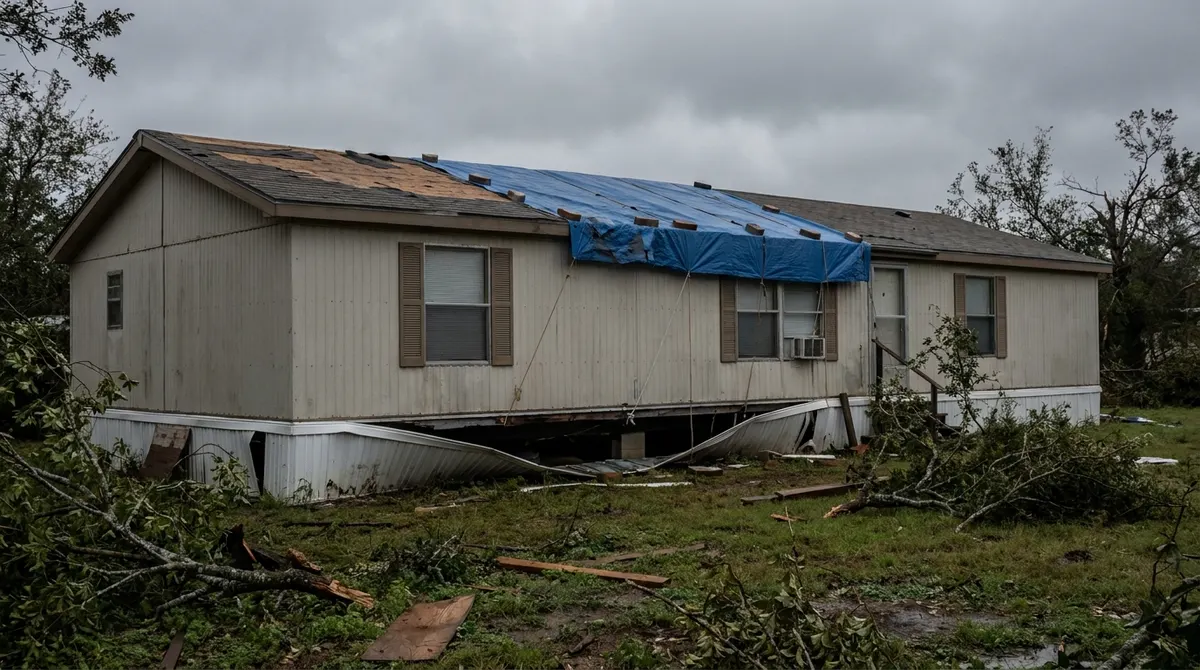
Whether the damage stopped. An active leak, an open roof, standing water, a hole in the envelope. Damage that is still progressing is priced far worse than the same damage stabilized, because the buyer is pricing what it will be at closing, not what it is today.
Smoke versus structure. Smoke and soot in a manufactured home permeate insulation, ductwork and porous surfaces and are unpleasant and expensive. Structure is different in kind. Once the frame, the floor system or the roof structure is compromised, the conversation moves from repair to whether the home has a future at all.
Water and time. Water damage in a manufactured home rarely stays where you can see it. It runs into the floor cavity, sits on the vapor barrier underneath, and works outward. Mold follows in a matter of days in a Texas summer. Two identical floods, one dried out in 48 hours and one left for three weeks, are not remotely the same asset.
Whether it can still be financed or placed. Structural floor damage generally fails lender inspections, which removes financed buyers entirely. A community will have its own condition standards, and a home that cannot meet them cannot be sold in place at any price to a buyer who wants to keep it there.
The risk allowance. As covered in our post on how a cash offer is calculated, damaged homes carry the largest uncertainty adjustment of anything we look at, because what is behind the wall is unknown and the history of these homes is that it is worse than it looked.
Salvage value, honestly
When a home genuinely has no future as a dwelling, it still has some value, and it is smaller than most owners hope.
There is value in the steel frame and axles, in appliances and HVAC equipment that survived, in windows and doors, and sometimes in the lot itself being cleared and made available. Against that sits the cost of demolition, hauling and disposal, which in the Austin metro is not trivial.
The honest framing is that a truly destroyed home is often a net cost to remove, and an offer on it is really an offer on the land, the lot, or the convenience of the problem going away. Anyone telling you otherwise about a burned-out shell is selling something.
Fire, Flood or Storm Damage?
Send us photos and your insurance paperwork. We will tell you whether the home is salvage and what that changes.
Get My Cash Offer →The sequence that protects your options
- Stop the damage. Tarp the roof, kill the water, get air moving. This is the highest return action available to you and it is available immediately.
- Document everything before anything is touched. Photos and video of every room, the exterior, the roof and underneath. Once a mitigation crew has been through, you cannot recreate it.
- Read your policy and talk to your lienholder. Actual cash value or replacement cost, the deductible, and who the loss payee is. If there is a loan, the lender controls more of this than you do.
- Ask the adjuster directly what settlement structure is being proposed. Specifically whether it is a full insured value payout. That is the salvage trigger under 1201.461 and it deserves a deliberate decision rather than a signature.
- Talk to your community, if you are in one. Condition standards and timelines for repair or removal are usually in the rules, and those rules are part of the lease.
- Get more than one offer, and get them on the same facts. Give every buyer the same photos and the same scope. Wildly different numbers usually mean somebody is pricing a different home.
When repairing is genuinely the better answer
It is not always sell. Repair tends to win when the damage is contained and contractor access is easy, when insurance is funding a meaningful share, when the home is on land you own and intend to keep, and when the home was in good condition before the loss.
Repair tends to lose when the damage reached the floor system or frame, when the home is older and was already carrying deferred maintenance, when the insurance settlement is far below the real scope, and when you are paying lot rent every month the work is not happening.
If you want a number on it
We buy fire, flood, storm and freeze damaged manufactured homes across Central Texas, including homes other buyers have walked away from. We work throughout the region, including Austin, Bastrop, New Braunfels and Waco, and as a TDHCA-licensed brokerage we deal with the salvage and Statement of Ownership rules as a matter of routine.
Send photos, including under the home if you can get there safely, and tell us what the insurer has offered so far. We will tell you what we see, what we would pay, and when the better answer is to take the repair money and fix it.
We Buy Damaged Manufactured Homes As-Is
No repairs, no cleanup, no contractor bids. We price the scope ourselves and show you how we got there.
Get My Cash Offer →This article is general information about Texas manufactured housing law, insurance and home construction. It is not legal, insurance or tax advice, and it is not a substitute for inspection by a qualified professional. Policy terms and settlement decisions vary. Consult a Texas attorney, a licensed public adjuster, or your own insurance agent about your claim.
Sources: Texas Occupations Code Chapter 1201, Manufactured Housing; TDHCA, Salvaged Manufactured Homes application procedures, MHD Form 1118; TDHCA Manufactured Housing Division; HUD Office of Manufactured Housing Programs