
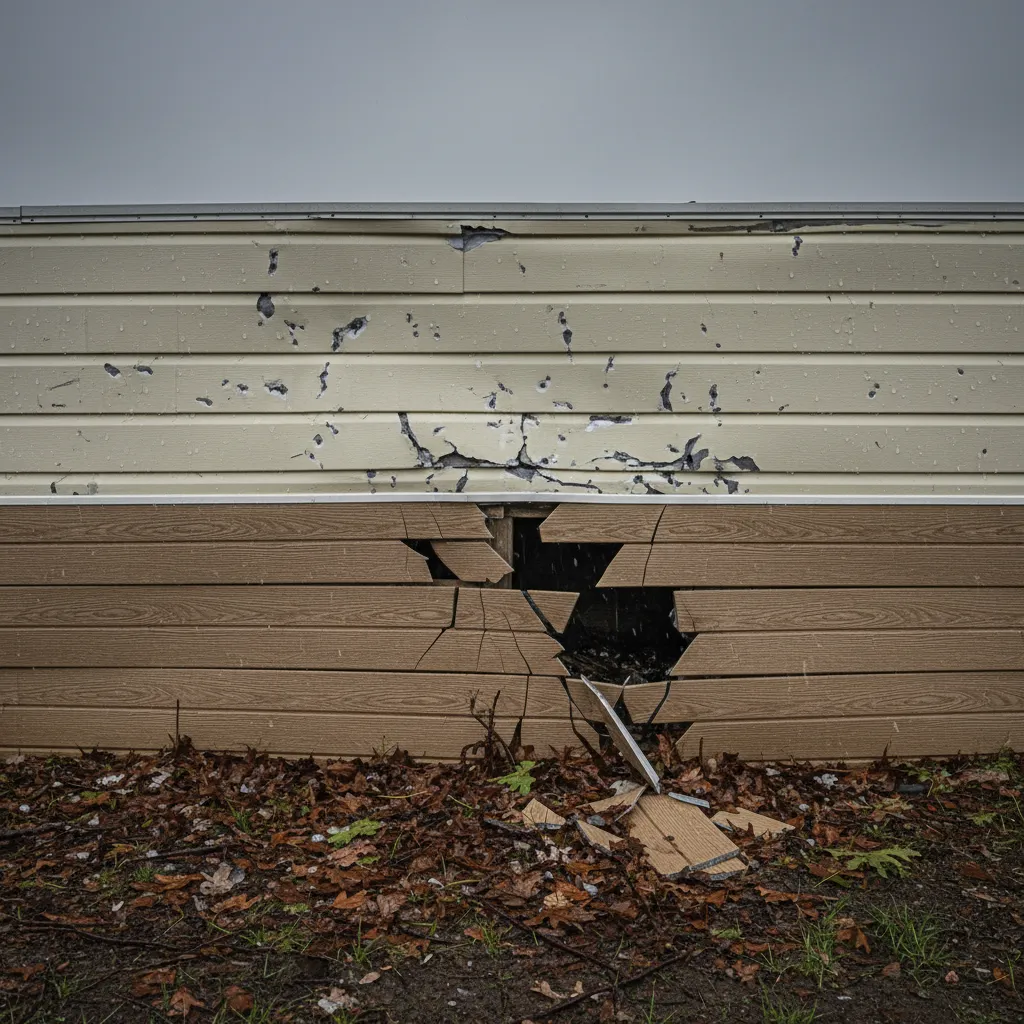
Texas weather is ruthless on manufactured homes. Softball-sized hail rolls through the Austin-Waco corridor every spring, Gulf Coast hurricanes pound Corpus Christi and Houston every few years, and Panhandle tornadoes can flatten a home in seconds. If a recent storm left your mobile home with a dented roof, punctured siding, shifted piers, or worse, you are probably staring down a difficult question: repair it, file an insurance claim and hope for the best, or cut your losses and sell as-is? This guide walks you through the full decision framework — insurance realities, typical payout math, contractor scams to avoid, and how selling a storm-damaged mobile home to a cash buyer actually works in Texas.
Common Mobile Home Storm Damage in Texas
Manufactured homes are built to HUD code, but they are still lighter, lower-profile, and more exposed than site-built houses. Certain failure patterns repeat after every major Texas storm. Knowing what to look for helps you document damage accurately for insurance and for any potential buyer.
- Roof damage: Hail strikes can bruise or fracture metal roofing panels, crack seams, and dent the standing-seam ribs. On shingle roofs (common on newer double-wides), hail knocks granules loose and can tear shingle tabs. Once the roof envelope is compromised, even a small leak can rot the OSB sheathing below within a single wet season.
- Metal siding dents: Vinyl and aluminum siding on older singles and doubles shows hail impact immediately. Dents are cosmetic on their own but often signal that the underlying sheathing absorbed the hit too.
- Skirting failure: Vinyl and metal skirting is fragile. High winds tear it off entirely or crack panels, exposing the belly of the home to pests, rodents, and freeze risk in winter.
- Tie-down and pier failure: Sustained high wind can lift a corner of the home and snap or loosen the steel anchor straps that tie the chassis to the ground. Piers can shift off their footings. This is serious — an un-leveled home stresses every door frame, window frame, and plumbing joint in the structure.
- Interior water intrusion: Once water enters through a damaged roof, around a broken window, or up through a compromised belly wrap, it saturates insulation, warps subfloor, and grows mold. Interior water damage is frequently worse than it appears from the outside.
- Window and door damage: Flying debris shatters glass and dents door panels. Broken windows that are not tarped quickly cause cascading interior damage.
- HVAC and exterior equipment: Hail destroys condenser fins on outdoor AC units. Even if the unit runs after the storm, bent fins reduce efficiency and shorten its remaining life significantly.
Document every area of damage with dated photos and video before any cleanup. Your insurer will want this evidence, and if you later sell to a cash buyer, it helps them price the offer fairly.
Understanding the Texas Mobile Home Insurance Claim Process
Mobile home insurance in Texas is not the same product as standard homeowners insurance, and the claim process has quirks that catch many owners off guard. Before filing, understand exactly what kind of policy you have and what it will actually pay.
Personal Property vs. Real Property Policies
Most manufactured homes in Texas are insured as personal property (sometimes called a mobile homeowners or MH-form policy) rather than real property. This matters because personal property policies often have lower coverage limits, different exclusions, and different depreciation schedules than a standard HO-3 homeowners policy. If your home is permanently affixed to land you own and has been converted to real property through TDHCA and county deed records, you may have a true homeowners policy — which usually offers better terms.
Pull out your declarations page before doing anything else. Identify whether you have a personal property or real property policy, the named perils or all-risk coverage, the dwelling limit, and every separate deductible.
Named-Storm and Wind-and-Hail Deductibles
In Texas, most policies carry a separate named-storm deductible or wind-and-hail deductible expressed as a percentage of the dwelling limit — not a flat dollar figure. A policy might have a $1,000 all-perils deductible but a 2 percent wind-and-hail deductible. On a home insured for $60,000, that 2 percent is $1,200 on the first claim and can be much higher on newer homes insured at higher values. During a named hurricane, a 5 percent deductible is not unusual.
This is the single biggest surprise to most mobile home owners after a storm: the deductible they assumed was $1,000 is actually several thousand on wind or hail damage. Always verify your exact deductible before filing.
Texas Windstorm Insurance Association (TWIA)
If your home is in a designated coastal county (the 14 first-tier coastal counties plus parts of Harris County), private insurers often refuse to cover wind and hail. In those areas, coverage is provided by the Texas Windstorm Insurance Association (TWIA), a state-chartered insurer of last resort. TWIA policies have their own rules: strict inspection requirements, compliance with the Texas windstorm building code (WPI-8 certification), and percentage deductibles that are almost always higher than inland policies. TWIA claims are also scrutinized heavily for pre-existing damage, so documentation from before the storm (prior photos, maintenance records) is gold.
Actual Cash Value vs. Replacement Cost
How much your insurer actually pays depends on whether your policy covers Actual Cash Value (ACV) or Replacement Cost Value (RCV).
Actual Cash Value pays the depreciated value of damaged property — essentially what the damaged item was worth the moment before it was destroyed, accounting for age and wear. On a 20-year-old roof, ACV can mean the insurer pays only a fraction of what a new roof costs. Most older personal property mobile home policies are ACV.
Replacement Cost Value pays what it costs to replace the damaged property with new equivalent materials, with no depreciation deduction. RCV is far better for you, but it typically requires a newer home, higher premiums, and sometimes a pre-insurance inspection. Some RCV policies pay ACV first and then release the depreciation holdback only after you complete the repairs and submit receipts.
If your policy is ACV and your home is more than 15 years old, expect the insurance payout to cover 30 to 60 percent of the true repair cost. This math alone often drives the decision to sell as-is rather than repair.
Repair vs. Sell: The Decision Framework
Once you understand what insurance will actually pay, you can make an honest repair-vs-sell decision. The core question is simple: after you pay your deductible and receive your insurance payout, will the post-repair value of the home exceed the remaining out-of-pocket repair cost plus your time, risk, and holding costs?
For most older manufactured homes in Texas, the answer is no. Here is why.
Typical Repair Costs on Manufactured Homes
- New metal roof on a double-wide: $8,000–$15,000
- New metal siding: $6,000–$12,000
- Interior water damage restoration (subfloor, insulation, drywall): $3,000–$10,000 per affected room
- Re-leveling and tie-down replacement: $1,500–$4,500
- New skirting: $1,500–$3,500
- Condenser AC replacement: $3,500–$6,500
- Window replacement: $400–$900 per window
A moderately storm-damaged home can easily need $15,000 to $35,000 in repairs. If your insurance payout after deductible is $10,000, you are out $5,000 to $25,000 of your own money before the home is sellable at retail — and that assumes the contractor finishes on time, on budget, and without surprises. Water damage especially has a way of revealing hidden problems mid-repair.
The Repair-to-Value Ratio Problem
Manufactured homes typically depreciate rather than appreciate. When you sink $20,000 into repairs, the home's retail value usually increases by only $12,000 to $15,000. The remaining $5,000 to $8,000 is money lost. Repairs can make sense on newer, well-maintained homes where the post-repair value genuinely covers your costs, but on most homes more than 10 years old, the math works against the owner.
When Retail Listing Still Makes Sense
If the storm damage is purely cosmetic — surface hail dents on siding, minor skirting loss, a handful of missing shingles with no water intrusion — and the home is otherwise well-maintained with a recent roof, good mechanicals, and a clean interior, listing on the open market may yield a higher sale price. If the damage is cosmetic only and you have time, listing your mobile home on the open market may yield a higher sale price than selling as-is, particularly if you are not under time pressure and can weather a 30 to 90 day sales process. This is a judgment call best made after an honest walk-through with someone who knows the local retail market for manufactured homes.
Red Flags: Contractor Chasers and Roofing Scams After Texas Storms
Within 48 hours of any significant Texas hail event or hurricane, out-of-state contractors (often called "storm chasers") flood the affected area. Some are legitimate. Many are not. After the 2022 and 2023 central Texas hail events, the Texas Attorney General issued multiple consumer alerts about post-storm contractor fraud. Here is what to watch for:
- Door-knocking with pressure tactics: A legitimate contractor almost never needs to show up unannounced demanding a signature today. Anyone pushing you to sign on the spot is a red flag.
- "Free roof" pitches: No roof is truly free. These pitches usually involve inflated insurance claims, Assignment of Benefits contracts, or kickback schemes that can leave you holding the bag.
- Out-of-state license plates and no local address: Storm chasers work the disaster circuit. They will be in your county for three months and then gone when problems surface. Texas requires contractors to register for certain work — verify their standing with the Texas Department of Licensing and Regulation.
- Deductible "waivers" or "rebates": Offering to cover your deductible is illegal in Texas under Insurance Code Section 707. Anyone proposing this is committing insurance fraud, and you become a party to it.
- Upfront full payment demands: Never pay in full before work is completed. A small deposit is normal; 100 percent upfront is not.
- No written contract or scope of work: Every job needs a detailed written contract listing materials, timeline, payment terms, and warranties. Verbal agreements are how people get cheated.
Assignment of Benefits: The Biggest Trap
An Assignment of Benefits (AOB) is a legal contract that transfers your right to collect your insurance proceeds directly to a third party — usually a contractor or restoration company. Once you sign an AOB, the contractor negotiates directly with your insurer, receives the insurance checks, and you have very little control over the process.
AOBs are a major driver of post-storm fraud in Texas. Contractors with an AOB often file inflated claims, perform substandard work, drag out repairs for months, or disappear with the money after the first check. Lawsuits involving AOB abuse have become so common that the Texas Legislature has tightened the rules multiple times, but they are still widely used.
You almost never need to sign an AOB to get your roof or siding repaired. A legitimate contractor can be paid directly by you after your insurer sends the claim check. Read every document before signing, do not sign anything in your driveway under pressure, and if a contractor insists on an AOB as a condition of taking the job, walk away. For more on post-storm fraud patterns, see our guide on mobile home cash offer scams in Texas.
Selling As-Is for Cash When There Is Storm Damage
Selling a storm-damaged mobile home to a cash buyer is the fastest way to convert a liability into cash — no repair bills, no contractor headaches, no months of holding costs, and no risk that an insurance claim drags on longer than you can afford to wait.
How an As-Is Cash Sale Works
- Property walk-through: A licensed buyer inspects the home, including the roof, siding, skirting, interior, and any visible water damage. Photos are taken for internal underwriting only.
- Offer: Within 24 to 48 hours, you receive a written cash offer reflecting the home's current as-is condition. If there is an open insurance claim, the buyer will ask how you want it handled (see below).
- Title review: The buyer verifies the Statement of Ownership (SOO) through TDHCA and checks for liens. Storm damage does not affect the title itself — only the condition of the physical home.
- Close: Closing typically happens in 7 to 21 business days. You sign the TDHCA transfer documents, receive your cash, and walk away from the home.
Handling an Open Insurance Claim at Closing
If you have already filed a claim but it has not settled, you have several options:
- Assign the claim proceeds to the buyer: You sign over your rights to the remaining claim payment in exchange for a higher purchase price. The buyer then deals with the insurer and pockets (or loses) whatever the claim ultimately pays.
- Keep the claim, sell the home: You retain the right to the claim proceeds and sell the home at its current as-is value. The buyer takes the home exactly as it sits; you continue negotiating with your insurer independently.
- Wait for the claim to settle: You and the buyer agree to delay closing until the claim is resolved, then proceed. This slows the sale but removes uncertainty.
Disclose the claim status before an offer is made. Claims are not a dealbreaker for most cash buyers, but they must be factored into the pricing and the closing structure. For other water-related damage scenarios, see our detailed guide on selling a water-damaged or flooded mobile home in Texas. If fire was part of the storm event — for example a lightning strike that caused an interior fire — our guide on selling a fire-damaged mobile home in Texas covers that scenario specifically.
Storm Damage Piling Up? Get a Cash Offer This Week.
No repairs, no contractors, no waiting on insurance. We buy storm-damaged mobile homes across Texas as-is and close in 7–21 days.
Get My Cash Offer →Texas Storm Patterns: Where Damage Happens
Where you live in Texas determines the type of storm damage most likely to affect your mobile home and how insurance treats it.
Central Texas Hail Alley (Austin, Waco, Killeen, Temple)
The I-35 corridor from Austin north through Waco is one of the most active hail regions in the United States. The combination of warm Gulf moisture, cool dry air from the Rockies, and afternoon instability produces severe thunderstorms with hail every spring from late March through June. Manufactured homes in Travis, Williamson, Bell, McLennan, and Hill counties see recurring hail damage to roofs, siding, skirting, and HVAC units. Insurance is available through private carriers, but wind-and-hail deductibles are typically 1 to 2 percent.
Gulf Coast Hurricanes (Houston, Corpus Christi, Beaumont, Galveston)
The Texas Gulf Coast takes a direct or glancing hit from a major hurricane on average every 6 to 8 years. Harvey (2017), Ike (2008), Rita (2005), and Harvey's successors have all devastated mobile home communities in Harris, Galveston, Nueces, Brazoria, and Jefferson counties. Coastal mobile homes are typically covered through TWIA with 5 percent named-storm deductibles and strict WPI-8 construction requirements. Flood damage from hurricane storm surge is a separate policy entirely — most standard policies exclude flood, so Gulf Coast owners should verify they carry National Flood Insurance Program (NFIP) coverage as well.
Panhandle and North Texas Tornadoes (Amarillo, Lubbock, Wichita Falls)
The Texas Panhandle and north-central Texas sit on the southern edge of Tornado Alley. Spring storms produce EF-2 and larger tornadoes that can total manufactured homes outright — the low profile and lighter construction of mobile homes make them particularly vulnerable. Tornado damage is usually covered under standard wind coverage, but total-loss claims involve their own challenges around Actual Cash Value math, removal of debris, and lot cleanup obligations.
East Texas Severe Thunderstorms (Tyler, Longview, Nacogdoches)
East Texas sees fewer tornadoes and less hail than central Texas but more straight-line wind events and tree-fall damage. A 100-year-old pine tree landing on a mobile home is a total loss scenario in most cases. Insurance typically covers this under wind, but tree removal can be excluded unless the tree actually hits the insured structure.
Timing: When to Act After a Storm
Texas insurance policies have notice-of-loss deadlines. Most require you to notify your insurer within 30 days of the damage, and some have shorter windows after named storms. Missing the notice deadline can forfeit your entire claim.
A practical action sequence after any significant storm:
- Immediately: Document everything with photos and video. Cover broken windows and tarp obvious roof damage to prevent additional loss. Your policy requires you to mitigate further damage.
- Within 24–48 hours: Contact your insurer to report the claim. Get the claim number in writing.
- Within the first week: Obtain written repair estimates from at least two licensed local contractors. These estimates become evidence during the adjuster's inspection.
- Adjuster inspection: Meet the adjuster on-site. Walk them through every area of damage. Provide your contractor estimates.
- Decision point: Once the claim is settled (or a clear estimate is in hand), decide: repair with the payout, repair with payout plus out-of-pocket money, or sell as-is.
If you are considering selling, you can start getting cash offers at any point in this timeline — even before the claim settles. A reputable buyer will factor the claim into their offer and give you options for how to handle it at closing. For a broader view of the full Texas selling process, see our complete guide to selling a mobile home in Texas in 2026.
FAQ: Storm-Damaged Mobile Homes in Texas
Can I sell a Texas mobile home with active hail damage?
Yes. You can absolutely sell a Texas mobile home with active hail damage, and in many cases it is the smartest financial move. Cash buyers who specialize in manufactured homes purchase storm-damaged properties as-is, meaning you do not need to repair the roof, replace dented metal siding, fix interior water damage, or obtain contractor estimates before selling. Because the repair-to-value ratio on older manufactured homes is often poor, selling as-is frequently nets more than repairing first and then selling.
Should I file an insurance claim before selling my storm-damaged mobile home?
It depends on the size of the damage relative to your deductible and whether you plan to keep or sell the home. If damage is minor and your windstorm or named-storm deductible is high (often 1 to 5 percent of the home's insured value in Texas), filing may not be worthwhile. If damage is significant, file promptly because most policies have strict notice deadlines. If you plan to sell, you can often assign the claim proceeds at closing or sell before the claim settles, depending on the buyer. Discuss the claim status with your cash buyer up front so it is handled cleanly.
How are Texas windstorm deductibles different from regular deductibles?
In Texas, most policies carry a separate named-storm or wind-and-hail deductible that is calculated as a percentage of the insured value rather than a flat dollar amount. A standard deductible might be $1,000, but the named-storm deductible on the same policy could be 2 to 5 percent of the dwelling limit. On a home insured for $60,000, a 5 percent named-storm deductible means you pay the first $3,000 of damage out of pocket before insurance contributes. Coastal properties through the Texas Windstorm Insurance Association (TWIA) almost always carry percentage-based deductibles.
What is Assignment of Benefits and should I sign one?
Assignment of Benefits (AOB) is a contract that transfers your right to collect your insurance claim proceeds directly to a third party, usually a contractor or restoration company. Once you sign an AOB, that contractor negotiates with your insurer, keeps the insurance check, and you lose most control over the claim. AOBs are a major source of fraud in Texas post-storm markets. Never sign an AOB under pressure from a door-knocking contractor. Read any paperwork carefully, consult an attorney if needed, and understand that you almost never need to sign an AOB to get your roof repaired.
Will a cash buyer still buy if I have an open insurance claim?
Yes, most cash buyers will still purchase a home with an open insurance claim. There are a few common ways this is handled at closing: the seller can assign remaining claim proceeds to the buyer in exchange for a higher offer, the seller can keep the claim and sell the home for its current as-is value, or closing can be structured to wait for the claim to settle first. Disclose the claim status up front so the buyer can structure a clean offer.
How much does storm damage reduce a mobile home's value?
It depends on the type and severity of the damage. Cosmetic hail dents on metal siding typically reduce value by 10 to 25 percent. Roof damage with active or prior water intrusion can reduce value 30 to 60 percent because interior sheathing, insulation, and subfloor damage is often hidden. Tie-down failure or shifted piers from high wind can require significant re-leveling work. Tornado or hurricane damage that affects the home’s structural frame often reduces value to salvage levels. A cash buyer evaluates each of these factors when calculating an as-is offer.
Is it worth repairing hail damage or selling as-is?
For most older manufactured homes in Texas, the repair-to-value ratio is poor. A new roof on a double-wide can cost $8,000 to $15,000, new metal siding $6,000 to $12,000, and interior water repairs another $3,000 to $10,000. If those repairs only increase the sale price by 60 to 70 percent of what you spent, selling as-is nets more. Repairs make sense only on newer, well-maintained homes where the post-repair retail value meaningfully exceeds the repair cost plus your time and risk. For a deeper look at fast sale timelines, see our guide on how to sell a mobile home quickly.
What if a tornado totaled my mobile home — can you still buy it?
Yes. Even a mobile home that is a total loss has residual value in the form of usable materials, appliances, fixtures, HVAC units, and the steel frame. Some buyers also purchase the lot occupancy rights or the land itself if the home was on owned land. We buy homes in any condition including those declared total losses by insurance. The offer will reflect the remaining value, but you will receive cash and be relieved of demolition, cleanup, and disposal responsibility.
Mobile Bye Bye buys storm-damaged mobile homes across Texas — hail, wind, hurricane, tornado, fallen trees, water intrusion, total losses. We handle open insurance claims, lot lease issues, and title complications. Call us at 737-214-0172 for a free, no-obligation consultation.
Disclaimer: This article is for informational purposes only. Mobile Bye Bye is a TDHCA-licensed manufactured home brokerage — we are not insurance adjusters, licensed public adjusters, attorneys, or financial advisors. Nothing in this article constitutes legal, insurance, financial, or tax advice. Consult a licensed professional for advice specific to your situation and policy.
Ready to Sell Your Storm-Damaged Mobile Home?
Get a no-obligation cash offer in 24 hours. No repairs, no insurance hassles, no commissions.
Get My Cash Offer →