
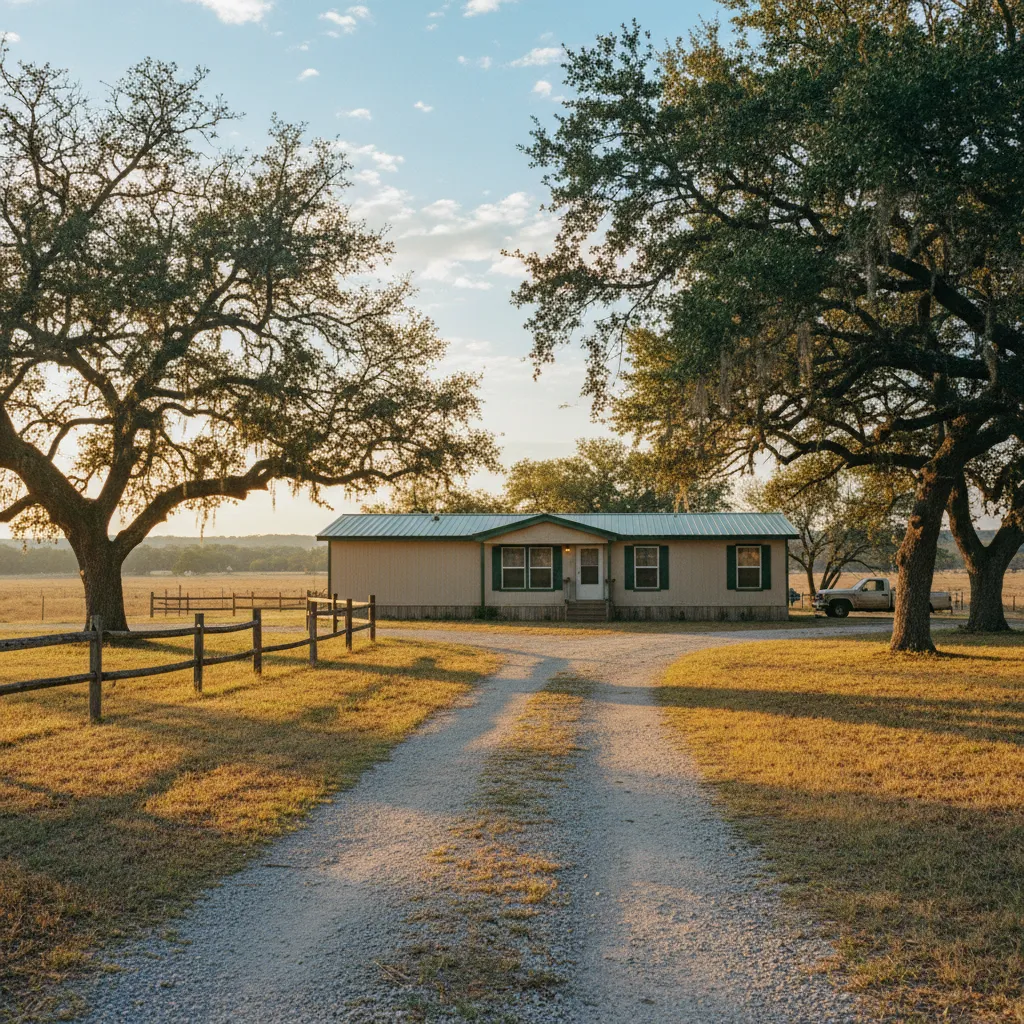
Selling a mobile home that sits on land your family owns is not the same as selling a home in a park or on a rented lot. You have more flexibility — and more decisions. The home and the dirt are two different assets under Texas law, each with its own title, its own transfer process, and its own buyer pool. Whether you keep the land, sell it separately, or package the whole thing together can change the sale price by tens of thousands of dollars and the timeline by months. This guide walks you through every path so you can pick the right one for your family.
The First Decision: Two Fundamentally Different Sales
When a manufactured home sits on family land, there are really only two sales you can make. Everything else is a variation of these two paths, and choosing between them is the single most important decision in the whole process.
Option A: Sell the Home Only
You keep the land. A buyer purchases the mobile home itself and either moves it off the property to a new location or signs a long-term lot lease with your family to keep it where it is. This path makes sense when the family wants to retain the acreage for future use, when the land has higher value than the home, or when heirs agree to keep the property in the family but do not want to keep the home standing.
Option B: Sell the Home and the Land Together
You sell the entire parcel as one package — the dirt plus the dwelling. A buyer gets a complete property, usually with the plan of living in it themselves or renting it out. This path makes sense when the family is ready to fully exit, when you want to maximize the sale price by offering a turnkey property, or when nobody in the family has a long-term plan for the land.
These two options require very different paperwork, attract very different buyers, and have very different price ceilings. Before you talk to anyone about selling, sit down with the other family members on title and decide which path you are on. Trying to do both at once — leaving it open — will confuse buyers and almost always reduces your final price.
Personal Property vs. Real Property: The Classification That Controls Everything
In Texas, every manufactured home has a classification that determines how it is titled, how it is taxed, how it can be financed, and how it transfers in a sale. The two classifications are personal property (PP) and real property (RP), and the difference matters enormously when the home sits on family land.
Personal Property (PP)
By default, a manufactured home in Texas is personal property. It is titled through the Texas Department of Housing and Community Affairs (TDHCA), which issues a document called the Statement of Ownership (SOO). This document functions like a car title — it lists the owner, the serial number (HUD label / Texas seal), any recorded liens, and the physical location.
Even if the home has been on the family land for forty years, it is still personal property unless someone filed paperwork to change that. Being on owner-occupied land does not automatically convert the home. For a complete overview of how TDHCA title works, read our Texas Statement of Ownership guide.
Real Property (RP)
A manufactured home becomes real property only when the owner formally elects to convert it through an Election for Real Property Status filed with TDHCA and recorded in the county deed records. Once converted, the home is legally part of the real estate — it transfers with the deed, is taxed like a site-built house, and qualifies for conventional mortgage financing.
The election requires:
- The home to be permanently installed on a qualifying foundation
- The owner to own the land (or hold a long-term lease typically 25+ years) underneath it
- All liens on the home to be released or simultaneously refinanced onto a single real estate note
- A TDHCA-issued Statement of Ownership showing the election, plus a Certificate of Attachment recorded with the county clerk
Why This Classification Matters for Your Sale
If the home is personal property, you can sell it separately from the land with relative ease. You transfer the TDHCA title to the buyer, collect the money, and the land stays in the family. You cannot, however, offer a buyer a conventional mortgage on the home alone.
If the home is real property, the home and land are legally fused. Selling them separately requires a formal severance process before the sale. On the upside, a real property home can be listed through a traditional Texas real estate agent and financed with conventional, FHA, or VA loans.
Before you do anything else, pull the most recent Statement of Ownership from TDHCA and look at the classification line. If you cannot find the paperwork, call TDHCA or have a licensed broker run the title. You cannot plan a sale without knowing what you are selling.
The Statement of Ownership Election: What to File and When
Many owners on family land are sitting on an old personal property title and have never thought about converting. That is fine — in most cases it is the right call. But before listing, you need to make an intentional decision: stay PP, or file the RP election?
Stay Personal Property If:
- You plan to sell the home only and keep the land
- You are selling to a cash buyer who does not need mortgage financing
- The buyer plans to move the home off the property
- There is an unreleased chattel lien on the home that cannot be paid off easily
- The land has ownership complications (heirs’ property, life estate, multiple co-owners) that make conversion impractical
File the Real Property Election If:
- You are selling the home and the land together as a package
- You want to attract retail buyers using conventional, FHA, or VA financing
- The home is on a permanent foundation and the title is clean
- All current owners of the home and land can sign the election
The conversion process typically takes 6–10 weeks from application to recorded certificate. If you are in a hurry, personal property is almost always the faster path. If you are trying to maximize the sale price to a retail buyer and have time to work with, real property often nets more after commissions and closing costs.
How Severing a Home from the Land Works
If the home has already been converted to real property — either by a previous owner or during a past refinance — and you now want to sell the home separately from the land, you need to sever it back to personal property. This is a formal TDHCA process, not something you can do informally.
Severance requires:
- Written consent from every person listed on the real property deed
- Written consent from any mortgage lender with a lien on the real estate (they almost always say no unless the mortgage is paid off)
- A new TDHCA application reissuing the Statement of Ownership as personal property
- A recorded severance instrument filed with the county clerk removing the home from the real estate
The mortgage consent requirement is the biggest obstacle. If there is an active mortgage on the property, the lender has no incentive to release part of their collateral and typically will not. The practical result is that a home with an active RP mortgage cannot be severed until the mortgage is paid off — usually at closing as part of the sale.
Severance is also common in scenarios where a buyer wants to move the home off the property. For a fuller treatment of moving and severing homes, see our guide on selling a mobile home that needs to be moved.
Selling When Multiple Family Members Own the Land
Family land rarely has one owner. More often it is a tangle of siblings, cousins, spouses, and heirs — sometimes with names on the deed from three generations ago. Texas law has a specific term for this situation: tenants in common or, when inheritance is involved, heirs’ property. Each type has implications for selling.
Tenants in Common
When two or more people own land together without a formal partnership or joint tenancy agreement, Texas treats them as tenants in common. Each owner has an undivided fractional interest in the whole property. To sell the land, every tenant in common must sign the deed. A single holdout can block a voluntary sale.
If one or more co-owners refuse to sell, the others can file a partition suit in Texas district court. The court can force a sale at auction with proceeds divided according to each owner’s fractional interest. Partition suits typically take 6–18 months and cost $10,000–$50,000 in legal fees. They are a last resort.
Heirs’ Property
When land is inherited without being formally probated, title remains in the deceased owner’s name but the heirs have equitable ownership under Texas intestacy law. Selling heirs’ property requires establishing the chain of ownership first, typically through:
- An Affidavit of Heirship signed by two disinterested witnesses and recorded in county deed records
- Or a formal Determination of Heirship by a Texas probate court
Without one of these, no title company will insure the sale and no lender will finance a buyer. The home itself, if titled to a specific deceased owner through TDHCA, also needs a parallel transfer. Our complete guide to selling a mobile home in Texas for 2026 covers title-chain issues in more detail.
Life Estate and Remaindermen
Some family land is held under a life estate, where one person (the life tenant) has the right to use the property during their lifetime, and other people (the remaindermen) inherit it automatically at death. Selling during the life tenancy requires agreement from both the life tenant and every remainderman.
Common life estate scenarios on family land include:
- A widowed parent living in the mobile home with a life estate deeded by the deceased spouse
- Adult children holding remainder interests while Mom or Dad lives there
- An aunt or uncle with a life estate carved out when the original owner transferred title years ago
If the life tenant wants to sell but a remainderman refuses, a sale is still possible but requires either negotiation to buy out the remainderman’s interest or a partition action. Always confirm the full chain of interests before listing.
Not Sure Where You Stand?
Send us the property address and we will pull the TDHCA title and land records for free, no obligation.
Get My Cash Offer →The Retail Buyer Reality: Who Actually Shows Up
One of the biggest disconnects we see in family-land sales is between what sellers expect from the market and who actually shows up to buy. Understanding the retail buyer pool for each type of property saves months of frustration.
Buyers for Personal Property Homes on Family Land
A retail buyer for a PP home in this scenario faces an immediate problem: they do not own the dirt and cannot easily finance the home. Their options are:
- Move the home: Pay $8,000–$25,000+ to transport and reinstall the home on land they do own or lease elsewhere. Most buyers will not do this unless the home is exceptionally priced.
- Sign a lot lease with your family: Pay rent to your family long-term. This only works if your family wants to become a landlord and the buyer trusts the arrangement.
- Chattel finance the home and lease the lot: Get a personal property loan (shorter term, higher rate) and sign a long-term lease. Qualifying is tougher than a standard mortgage.
The practical result: most retail buyers will not buy a personal property home unless they can either move it cheaply or get a lease arrangement they trust. The buyer pool is small.
Buyers for Real Property Homes with Land
A buyer for a package sale has a much easier time. They get financing just like a regular home purchase, move in on closing day, and own the whole thing outright. The buyer pool is large: first-time homebuyers, rural buyers, retirees, and investors all consider this path. This is why converting to real property and selling as a package often commands a higher price per square foot than selling the home and land separately.
Pricing Implications
Because the PP buyer pool is so small, PP homes on family land typically sell for 30–50% less than what they would fetch as part of an RP package sale. That price gap is the cost of keeping the land. Sometimes that is the right trade-off; sometimes it is not. Run the numbers both ways before committing. If you want to understand how professional appraisal differs from rough book values, our article on mobile home appraisal vs. NADA book value breaks down the methodology.
The Cash Buyer Advantage in Family-Land Situations
A direct cash buyer solves most of the structural problems in a family-land sale because the buyer is not constrained by conventional financing rules, traditional listing timelines, or retail buyer pickiness. Cash offers work equally well for:
Home-Only Purchases
If you want to keep the land, a cash buyer can purchase just the home and either move it or negotiate a mutual lease. We do not need mortgage approval, so there is no back-and-forth with lenders about why the buyer does not own the land underneath. We close on the TDHCA Statement of Ownership alone and coordinate the transfer.
Package Purchases
If your family is ready to fully exit, a cash buyer can purchase the home and the land together in a single transaction. The cash offer eliminates financing contingencies, appraisal disputes, and the conventional 30–60 day escrow timeline. Closings on package sales with clear titles can happen in 14–21 business days.
Complicated Title Situations
Most retail buyers walk away the moment they hear “heirs’ property” or “life estate.” A cash buyer with experience in manufactured housing can work through these complications with you — paying for the Affidavit of Heirship, coordinating with the remainderman, settling back taxes at closing. You do not have to clean up the title before talking to us; we can help clean it up as part of the deal. For more on fast-close scenarios, read our guide on how to sell a mobile home quickly.
How a TDHCA Broker Coordinates with a Real Estate Agent
When a sale includes both personal property (the mobile home) and real property (the land), two licenses are technically at work: a TDHCA broker for the home and a Texas real estate agent or broker for the land. This is often confusing for family sellers who expect one agent to handle everything.
How the Two Roles Fit Together
A TDHCA-licensed broker handles:
- Pulling and reviewing the Statement of Ownership
- Preparing TDHCA Form T (Application for Statement of Ownership) for the title transfer
- Handling the Real Property Election or severance if needed
- Coordinating the payoff of any chattel liens on the home
- Representing the seller’s interest in the home portion of the transaction
A Texas real estate agent handles:
- Listing the land on the MLS (if going retail)
- Preparing the TREC real estate contract
- Coordinating with a title company to issue the land title policy
- Managing the deed preparation and county recording
If the home has been converted to real property, the land agent can handle the whole transaction because it is treated as one parcel. If the home is still personal property, the TDHCA broker and the real estate agent split the work, both closings happen simultaneously at the title company, and commissions are negotiated separately for each side.
Why a Cash Buyer Simplifies This
A direct cash sale through Mobile Bye Bye eliminates the dual-agent coordination entirely. We handle both the personal property transfer and the real estate deed ourselves (or through a title company we work with), paying all closing costs. For sellers dealing with family drama, out-of-state relatives, or time-sensitive situations, this is often worth more than a small premium on the retail sale price.
If you are considering financing options for a retail sale, including offering a land contract or owner-financing to a buyer, read our article on seller financing a mobile home in Texas.
A Practical Step-by-Step for Family-Land Sellers
Here is the sequence we recommend for families who want to sell a mobile home on land they own:
Step 1: Pull the most recent Statement of Ownership from TDHCA and determine whether the home is PP or RP.
Step 2: Pull the land deed from the county clerk and list every owner. Note whether anyone is deceased or holds a life estate.
Step 3: Have a family conversation and decide: home-only sale, or package with land?
Step 4: If any title issues exist (missing heirs, outdated deed, life tenancy, unpaid taxes, unreleased liens), document them and decide whether to resolve before listing or as part of the sale.
Step 5: Choose a sale path: cash buyer, TDHCA broker listing, or a coordinated listing with both a TDHCA broker and a real estate agent.
Step 6: If converting to real property, file the election 6–10 weeks before you want to close. If staying personal property, no conversion is needed.
Step 7: Get every person on the home title and the land deed to commit in writing before accepting an offer.
Step 8: Close. All signatures, all documents, all closing costs reconciled at one table, whether that is a title company or a direct cash transaction.
FAQ: Selling a Mobile Home on Family Land in Texas
Is my mobile home real property or personal property if it’s on family land?
It depends on whether a Real Property election has been filed with TDHCA. By default in Texas, a manufactured home is personal property titled through TDHCA with a Statement of Ownership, even when it sits on land the family owns. It only becomes real property if the owner formally elects to convert it by filing an Election for Real Property Status with TDHCA and recording the required documents in the county where the land is located. If no election was ever filed, the home is still personal property regardless of how long it has been there or whether the family owns the land.
Can I sell my mobile home separately from the family land it sits on?
Yes, as long as the home is classified as personal property with TDHCA. A personal property home can be sold by itself through a TDHCA title transfer, with the buyer either keeping the home on the same land under a new lease with the family or moving it to a new location. If the home has been converted to real property, it must first be severed from the land through a TDHCA severance filing before it can be sold separately. A TDHCA-licensed broker can determine the home’s current classification and handle the paperwork either way.
What is a Real Property election with TDHCA and should I file one?
A Real Property election is a formal TDHCA filing that converts a manufactured home from personal property to real property by legally affixing it to the land. It requires the home to be on a permanent foundation, the owner to own or have a long-term interest in the land, and a Statement of Ownership showing the election along with a recorded certificate filed in the county deed records. You should file one only if you plan to sell the home together with the land to a traditional retail buyer using mortgage financing, because most conventional lenders require real property status. If you plan to sell the home separately or keep the land, leave it as personal property.
Do I need permission from other family members to sell the mobile home if the land is shared?
For the home itself, only the owners listed on the TDHCA Statement of Ownership must sign. If the home is titled in your name alone, you have authority to sell it as personal property. For the land, every co-owner named on the deed must sign if you are selling land along with the home. In heirs’ property situations where the land was inherited without probate, you may need an Affidavit of Heirship or a formal partition to sell the land. You can often sell just the home without disturbing the land ownership if the buyer moves the home or signs a new lease with the family.
What happens to the mobile home if the land is sold?
It depends on the home’s classification. If the home is personal property, it does not automatically transfer with the land sale — the seller must either include it in the contract as a separate item, move it off before closing, or negotiate a new lease with the land buyer. If the home is real property through a filed election, it transfers automatically as part of the real estate deed just like a site-built house. Many family land sales get complicated when this distinction is not addressed clearly in the purchase contract. A TDHCA broker can advise on the correct approach before listing.
Can a buyer get financing for a mobile home sitting on land I’m keeping?
Yes, but only certain types of financing work. A buyer cannot get a traditional mortgage on a home without also owning or having a long-term lease on the land. Buyers typically use a chattel loan (personal property financing) to purchase the home, then sign a long-term lot lease with your family for the land. Chattel loan terms are shorter and rates are higher than mortgages, which narrows the buyer pool. Many buyers in this scenario pay cash. Cash buyers like Mobile Bye Bye purchase the home outright without needing any financing at all.
Do I need a traditional realtor if I’m selling both the home and the land?
For a package sale including the land, you generally need both a TDHCA-licensed broker for the home and a licensed Texas real estate agent for the land portion, unless the home has already been converted to real property through a filed election. If the home is real property, a traditional Texas real estate agent can handle the entire transaction because it is treated as one parcel of real estate. If the home is still personal property, the two transactions are separate and coordinated at closing. A cash buyer experienced in manufactured housing can handle both sides simultaneously without separate agents.
How does a TDHCA broker handle a package sale with land?
When a home is personal property and the seller wants to include the land, a TDHCA broker prepares and files the TDHCA title transfer for the home while coordinating with a licensed Texas real estate agent or title company on the land deed. Both closings happen simultaneously so that the buyer receives a complete property. If the seller prefers to convert to real property first, the broker can prepare the Election for Real Property Status, file it with TDHCA, and record the certificate with the county before listing. Either path works; the right choice depends on the buyer pool, financing, and timing.
Mobile Bye Bye handles family-land sales across Texas every month. We work with heirs’ property, life estates, multiple co-owners, and every classification scenario TDHCA recognizes. Call us at 737-214-0172 for a free, no-obligation consultation.
Disclaimer: This article is for informational purposes only. Mobile Bye Bye is a TDHCA-licensed manufactured home brokerage — we are not attorneys, financial advisors, or legal professionals. Nothing in this article constitutes legal, financial, or tax advice. Consult a licensed Texas attorney for advice specific to your family’s situation, especially when title, heirship, life estates, or partition are involved.
Ready to Sell Your Mobile Home on Family Land?
Get a no-obligation cash offer in 24 hours. We handle the home, the land, and every title complication in between.
Get My Cash Offer →