
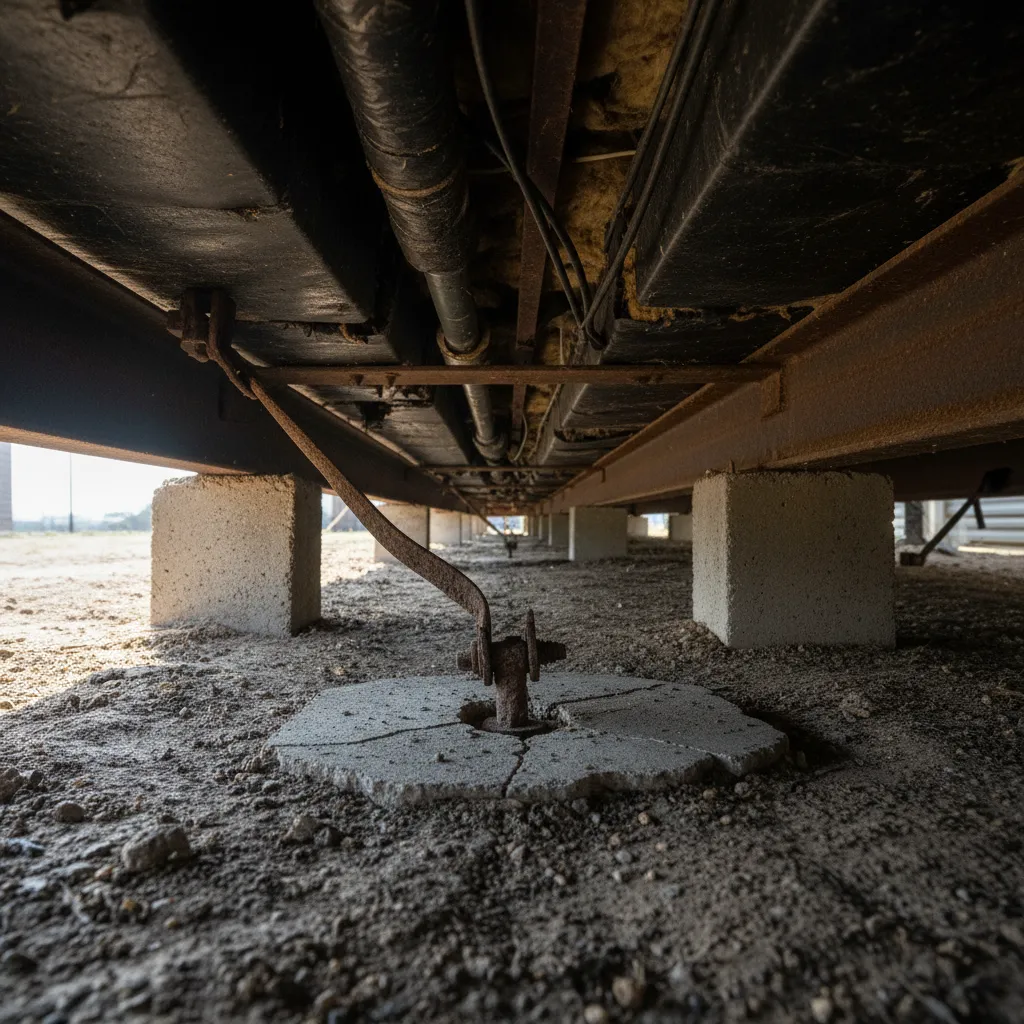
If the floors in your Texas mobile home feel bouncy, interior doors rub their frames, drywall cracks keep reappearing, or you have looked under the skirting and noticed piers leaning or cracked — you are dealing with a foundation problem. It is one of the most common and expensive issues Texas mobile home owners face, especially in central Texas where expansive clay soil moves several inches between wet and dry seasons. This guide covers how Texas support systems work, what causes them to fail, what repairs cost in 2026, how lenders view foundation issues, and your realistic options for selling.
How Texas Mobile Home Support Systems Actually Work
Unlike site-built houses that sit on a poured slab or continuous perimeter wall, most manufactured homes in Texas are supported on a pier-and-anchor system. Understanding the components helps you identify which part has failed and what the realistic repair path looks like.
Concrete Runners
On many central Texas installations, two continuous concrete runners are poured along the length of the home, one under each steel I-beam of the chassis. Piers sit on the runners rather than directly on soil, spreading the load and reducing the risk of individual pier settling. Runners are common but not universal.
Concrete Piers and Pier Pads
Stacked concrete blocks (piers) support the chassis beams at intervals of 8 to 10 feet. Each pier sits on a pad — poured concrete footings, precast concrete pads, or engineered ABS plastic pads approved by the Texas Department of Housing and Community Affairs (TDHCA). Shims between the pier stack and the chassis transfer load and keep the home level.
Anchors and Tie-Down Straps
Steel straps wrap over the chassis or the home itself and connect to ground anchors driven 4 feet or more into the soil. They keep the home from lifting or sliding during high winds. Texas is divided into Wind Zone II (most of the state) and Wind Zone III (coastal counties within roughly 100 miles of the Gulf). Wind Zone III requires more anchors, shorter spacing, and heavier-gauge straps.
Engineered Permanent Foundations
When a home is converted to real property, a licensed engineer designs and certifies a permanent foundation — a monolithic slab or perimeter wall with interior piers. The chassis is permanently bolted down, the tongue and axles are removed, and the home is titled through county deed records. This is required for FHA, VA, and most conventional mortgages.
The Texas Soil Problem: Expansive Clay and the Blackland Prairie
A strip of central Texas running from the Red River through Dallas, Waco, Austin, and San Antonio sits on the Blackland Prairie, named for its dark, highly expansive clay. These soils swell when they absorb water and shrink back aggressively during drought. The ground under your piers moves vertically with the seasons and the rainfall.
What this looks like in real life:
- After a wet spring, the soil expands and pushes some piers upward. Others stay put. The home is no longer level.
- During a hot dry summer, clay pulls away from foundation components. Piers that were snug are now loose and can tilt or fall.
- Homes installed directly on clay without runners or properly sized pads settle much faster.
- Some central Texas owners relevel every 3 to 5 years as a routine maintenance cost.
Outside the Blackland Prairie — East Texas sandy loam, Panhandle caliche, most of West Texas — soils are more stable and piers fail far less often. If you are in the I-35 corridor or anywhere with heavy black clay, seasonal pier movement is the default condition, not the exception.
Warning Signs Your Foundation Is Failing
Most foundation problems do not announce themselves with a dramatic crack. They creep in gradually, and many owners chalk up early symptoms to the age of the home. Here are the signs that experienced installers and inspectors look for, in roughly the order you will notice them.
Inside the Home
- Floor bounce or soft spots: A floor that gives when you walk across it can indicate a pier has shifted or settled away from the chassis.
- Uneven floors: Place a marble on the floor. If it rolls consistently toward one wall, the home is out of level.
- Doors that rub or will not latch: Interior doors that bind against the frame usually mean the wall above them has moved.
- Cabinet doors that will not close flush: Cabinets were installed level. If they are no longer closing evenly, the wall has moved.
- Drywall cracks: Cracks running diagonally from window and door corners, or along ceiling-to-wall seams, indicate structural movement — especially cracks that keep returning after patching.
- Gaps at trim and baseboards: Crown molding pulling away from the ceiling or shoe molding lifting from the floor signals shifting.
Outside and Underneath
- Skirting gaps: If one side is snug against the siding and the other has a 2-inch gap, the home is sitting at an angle.
- Cracks in skirting or runners: Hairline vertical cracks are cosmetic. Diagonal or stepped cracks indicate soil movement.
- Tilted piers: Piers should be plumb. A visibly tilted pier is no longer carrying its load correctly.
- Rusted or broken tie-down straps: Straps with through-holes, broken links, or disconnected anchors need replacement.
- Anchors pulling out: A failed anchor disc will be partially lifted out of the dirt.
- Soil erosion around piers: Water runoff has scoured soil away from the pier base, removing proper support.
If you see two or three of these symptoms together, you almost certainly have a real foundation problem and not cosmetic settling. If you see one isolated symptom — a single crack, or one door that sticks in humid weather — it may be nothing more than normal seasonal movement.
What a TDHCA Installer or Inspector Actually Checks
A licensed installer’s evaluation is grounded in TDHCA installation standards and the manufacturer’s set-up manual. The typical checklist:
- Levelness: Laser or water-level readings, typically within 1/4 inch over any 10-foot span.
- Pier spacing and condition: Piers at manufacturer-required spacing (usually 8 to 10 feet), plumb, on approved pads.
- Marriage-line support (double-wides): Additional piers and ridge-beam support along the centerline where sections join; failure causes center-of-home sag.
- Tie-down count and condition: Strap and anchor count against wind-zone requirements, strap corrosion check, anchor pull-test.
- Perimeter blocking: Sidewall piers where required.
- Ventilation and skirting: Adequate ventilation to prevent moisture buildup and metal corrosion.
An inspection runs $150 to $400 and produces a written report. Useful before listing retail. Not needed for an as-is cash sale.
Real-World Repair Costs in Texas (2026)
These are current Texas market ranges for licensed installer work. Prices vary by region, home size, and access conditions. Homes on leased park lots are often a few hundred dollars more expensive because of limited workspace under the home.
Releveling Only
- Single-wide: $1,500 to $2,500
- Double-wide: $2,500 to $4,000
The installer jacks up the home in sections, resets or shims piers, and restores level. It does not solve the underlying soil problem — on Blackland Prairie clay you may repeat every 3 to 5 years.
Full Re-Pier
- Single-wide: $4,000 to $6,000
- Double-wide: $5,000 to $8,000
When piers have cracked, badly tilted, or sit on failed pads, each is demolished and rebuilt with new blocks on new engineered pads. More durable than a relevel.
Tie-Down Replacement
- Single-wide: $1,500 to $2,500
- Double-wide: $2,500 to $3,500
New anchors driven, new straps installed, system brought into Texas wind-zone compliance. Often bundled with a relevel.
Engineered Permanent Foundation Upgrade
- Perimeter wall on piers: $15,000 to $25,000
- Full slab conversion: $25,000 to $35,000 or more
A major project. Engineer designs the foundation, the home is lifted, concrete is poured and cured, and the home is lowered and permanently attached. Tongue and axles removed, title surrendered to TDHCA, home becomes real property. Required for most conventional, FHA, and VA mortgages.
These ranges are broker estimates based on current Texas contractor quotes, not firm bids. Always get two or three written quotes from TDHCA-licensed installers before committing to any repair.
How Retail Lenders View Foundation Problems
If you want a retail buyer to pay near market price for your home, they almost always need financing. And the financing they can get is the single biggest factor in how foundation problems affect your ability to sell retail.
Chattel Loans (Personal Property Financing)
The major chattel lenders — 21st Mortgage, Triad Financial, Cascade — require installation per HUD and TDHCA standards. Their inspectors flag:
- Homes that are visibly out of level
- Missing or damaged tie-downs
- Shifted, cracked, or fallen piers
- Settling-related water damage (cracked subflooring, rotted joists)
If these show up, the loan is conditioned on remediation before funding. Our chattel loan guide walks through what these lenders look for in detail.
FHA Title I and Title II
FHA Title I finances the home without real estate; Title II finances it as real property on permanent foundation. Both are stricter than chattel. Title II almost always requires an engineer-certified permanent foundation. A pier-supported home cannot be financed with Title II until converted.
Conventional Mortgages
Conventional mortgages on manufactured homes require permanent foundation, real property status, and engineer certification. A pier-supported home in a leased park is effectively unfinanceable conventionally.
Cash Buyers
Cash buyers have no lender requirements. Foundation condition becomes a pricing issue, not a financing issue. They deduct repair cost from the offer or absorb it — often the only practical path for homes with serious pier or tie-down problems.
Repair and List, or Sell As-Is? How to Decide
There is no universal right answer. The decision depends on four variables: how severe the problem is, how much time you have, how much cash you can put in up front, and how much the repair will move the needle on sale price.
When Repair-Then-List Usually Wins
If the issue is relatively minor — a simple relevel or a handful of tie-down replacements — and the home is otherwise in good condition, repairing first and listing at retail is often the higher-net-dollars path. A $2,500 relevel can unlock chattel financing for a retail buyer and add $8,000 to $15,000 to the achievable sale price.
If the issue is minor settling that a $2K–$4K relevel can fix, and you have 60–90 days, listing your mobile home on the retail market after repairs can yield more than a cash offer. This path works especially well when your home is in a desirable park or on private land, and the only real obstacle to retail sale is the pier issue.
When As-Is Cash Usually Wins
As-is cash typically nets more (after you account for all costs and time) in these situations:
- The home needs $8,000+ in foundation work you would have to pay up front
- You don’t have the cash to fund repairs or the credit to borrow them
- You need to move or resolve the estate quickly — within 30 days
- The home also has other issues (older roof, outdated kitchen, cosmetic damage) that would need addressing before retail
- The home is on a leased lot and you are accruing lot rent each month it sits
- The home is out of state from where you live, making repair management impractical
When you add up holding costs (lot rent, insurance, utilities, property tax) across a 60-to-90-day repair-and-list process, plus the repair bill itself, plus the 6–10% commission on a retail sale, the gap between cash and retail net is often much smaller than the sticker-price difference suggests. Read our guide to selling a mobile home quickly for a fuller comparison of the two timelines and what they produce.
How an As-Is Cash Sale Works When the Foundation Is Failing
Selling a home with pier, tie-down, or foundation problems for cash is straightforward with a buyer who specializes in manufactured homes:
- Initial conversation. You describe the home: year, size, location, foundation condition. We ask for photos. No inspection, no cost.
- Offer within 24 hours. Written cash offer that accounts for the repair. No contingencies.
- Title review. We pull the TDHCA Statement of Ownership to verify title. Clean title = 7 to 14 business day close. Title issues — missing, deceased prior owner, unpaid taxes — we work through them with you.
- Closing. Title company, attorney, or remote where allowed. You sign the SOO transfer, funds wire or cashier’s check, home is ours. We handle foundation work afterward.
You never commission an inspection, get certification, hire an installer, or make repairs. No commissions, no closing costs. For a full walkthrough, see our complete guide to selling a mobile home in Texas in 2026.
Foundation Problems? No Problem.
We buy Texas mobile homes with failing piers, missing tie-downs, or settling damage. No inspections, no repairs, no commissions.
Get My Cash Offer →Foundation Problems Rarely Travel Alone
If the home has been out of level for years, other systems are usually affected. The related problems that often show up alongside pier issues are worth knowing so you are not surprised:
- Subfloor and joist damage: Uneven settling makes floor joists carry load unnaturally. Subfloor plywood cracks, and moisture from a shifted skirting line accelerates rot.
- Plumbing line stress: When the chassis rises on one side and falls on the other, PEX and ABS drain lines can be pulled loose at joints. Persistent under-home leaks often accompany settling.
- Water damage: Poor drainage around a settled home leads to moisture under the floor or wicking into wall framing. If you are also dealing with moisture, see our guide on selling a water-damaged mobile home in Texas.
- Market value impact: Appraisers mark foundation-compromised homes down significantly. Our article on mobile home appraisal vs. NADA book value explains why book value rarely equals sale price.
- Relocation: If the park no longer wants the home, it may need to move. Our piece on selling a mobile home that needs to be moved covers transport permits, costs, and feasibility.
FAQ: Selling a Mobile Home with Foundation Problems in Texas
What are the most common foundation problems on Texas mobile homes?
The most common issues are shifting or settling concrete piers, cracked or crumbling ABS pier pads, rusted or broken anchor straps, loose or missing tie-downs, and concrete runners that have cracked or heaved due to expansive clay soil. Central Texas homes on Blackland Prairie clay are especially prone to seasonal movement as the soil swells with moisture and shrinks during drought. The result is floors that feel bouncy, interior doors that rub or won’t latch, drywall cracks radiating from window corners, and visible gaps where the skirting meets the home.
Can I sell a mobile home with failing piers in Texas?
Yes. You can sell a mobile home with pier problems in Texas, and you are not legally required to repair anything before listing or selling. Retail buyers using financing will almost certainly require the home to pass a foundation inspection before the loan funds, so you either repair the piers first or accept a cash buyer who purchases as-is. Cash buyers factor the repair cost into their offer and handle all of the work after closing.
How much does it cost to relevel a manufactured home in Texas?
A straightforward releveling on a single-wide typically runs $1,500 to $2,500. Double-wides generally cost $2,500 to $4,000 because of the marriage-line support work. If piers need to be replaced, pads upgraded, or tie-downs re-anchored, the total can climb to $4,000 to $8,000. An engineered permanent foundation upgrade is a completely different project and typically runs $15,000 to $35,000 or more depending on site conditions and whether a slab or perimeter wall is required.
Will a chattel lender finance a mobile home with foundation issues?
Most chattel lenders, including 21st Mortgage, Triad, and Cascade, require documentation that the home is properly set on piers and tied down per manufacturer and HUD specifications. Visible settling, missing tie-downs, or failed piers will generally cause the loan to be declined until the issues are remediated. FHA Title I and Title II loans have even stricter foundation requirements and typically require an engineered permanent foundation certification. If your buyer is financing, foundation problems almost always need to be fixed before closing.
Do I need a foundation certification to sell my mobile home?
Not when you sell as-is to a cash buyer. Foundation certifications are typically required by FHA, VA, and some conventional lenders before they will finance a manufactured home purchase. If your buyer is paying cash or using chattel financing that does not require certification, no engineer report is needed. Mobile Bye Bye purchases homes without requiring any foundation inspection or certification from the seller.
What’s the difference between pier supports and an engineered foundation?
Pier support is the standard installation method for manufactured homes on leased land or non-permanent sites. Concrete blocks or runners sit on compacted soil, supporting the steel I-beam chassis, with tie-down straps anchoring the home against wind. An engineered permanent foundation converts the home to real property: a concrete slab or perimeter wall is poured, the chassis is permanently attached, and a licensed engineer certifies the installation. Engineered foundations are required for most conventional, FHA, and VA real estate mortgages. Pier installations are standard for chattel financing and park homes.
Can I sell my mobile home if the tie-downs are rusted or missing?
Yes. Missing or corroded tie-downs are extremely common on older Texas mobile homes, especially in coastal and high-wind zones where anchors have been exposed to moisture for 20 or 30 years. You can sell the home as-is to a cash buyer without replacing any straps. If you intend to list on the retail market or sell to a financed buyer, tie-down replacement is usually required because lenders and insurers check for compliance with Texas wind-zone standards before closing.
How quickly can Mobile Bye Bye close on a home with foundation problems?
If the title is clear and in your name, we can typically close in 7 to 14 business days regardless of the foundation condition. We do not require any inspection, certification, or repair work from the seller. We handle the releveling, pier replacement, or tie-down remediation ourselves after closing. For urgent timelines we can sometimes close in under a week when the title is ready.
Mobile Bye Bye buys Texas manufactured homes in any structural condition — failing piers, missing tie-downs, settling damage, and homes that can no longer pass a foundation inspection. Call 737-214-0172 for a free, no-obligation cash offer.
Disclaimer: This article is for informational purposes only. Ivan Mills is a TDHCA-licensed manufactured home broker — not a licensed installer, structural engineer, or foundation contractor. Repair cost ranges cited here are general market estimates current to 2026 and are not bids. Always get written quotes from TDHCA-licensed installers and, where structural concerns exist, consult a licensed Texas professional engineer. Nothing in this article constitutes legal, engineering, or construction advice.
Ready to Sell As-Is and Skip the Repair Bill?
Get a no-obligation cash offer in 24 hours. No inspection, no foundation work, no commissions.
Get My Cash Offer →