
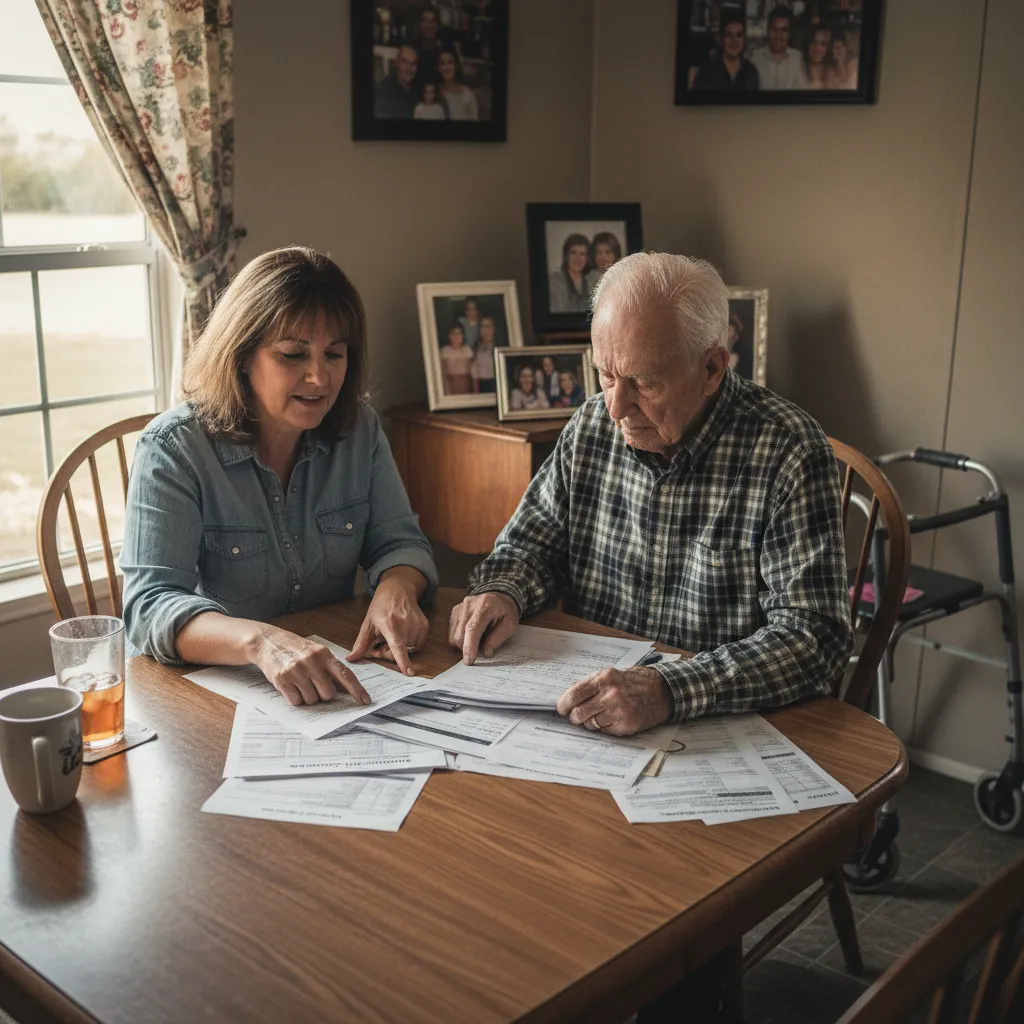
You just walked out of a meeting at an assisted living facility, or picked up the phone after another scary fall. Mom or Dad cannot live alone anymore, the facility needs a deposit this month, and the only real asset in the family is the mobile home they have lived in for twenty years. This guide walks you through turning that home into cash quickly — without hurting Medicaid eligibility, breaking Texas law, or adding guilt to grief.
The Emotional and Practical Reality
For most adult children, the mobile home is where Thanksgiving happened and where a parent has been independent for decades. Selling it feels like closing a chapter they may not be ready to close. A few things to hold onto:
- The home is a means, not the meaning. Its value is that it can buy quality care and dignity in your parent’s next chapter.
- Speed is usually kinder. Every month of delay is lot rent, utilities, and insurance draining money that could have gone toward care.
- Involve your parent when you can. If they still have capacity, walk through the decision with them.
- Align siblings early. Disagreement between adult children is the biggest source of delay. A 30-minute family call up front saves months of friction.
Power of Attorney and Guardianship in Texas
If your parent is still living, you cannot simply sell their mobile home — not even as their only child, not even if you have been paying their bills for years. Texas requires legal authority, and it comes from one of three places: your parent signs the documents themselves, a valid Power of Attorney names you as agent, or a court appoints you as guardian.
When Your Parent Can Still Sign
If your parent still has legal capacity, the cleanest path is for them to sign the TDHCA title transfer and closing documents directly. Mobile Bye Bye routinely sends a notary to an assisted living facility, hospital room, or family home for signings. This is the fastest and least expensive option by a wide margin.
Durable Power of Attorney (DPOA)
A Durable Power of Attorney executed while your parent still has capacity is the key legal tool when incapacity is anticipated. The Statutory Durable POA form from the Texas Estates Code (Chapter 752) is most commonly used. It must be signed, dated, notarized, and grant the agent explicit authority over real and personal property. Critical requirements for TDHCA:
- Durable: Remains effective after incapacity. A plain POA that terminates on incapacity is useless once dementia progresses.
- Specific authority: Grants general authority over personal property and real estate, or specifically authorizes sale of the manufactured home.
- Notarized and capacity-sound: TDHCA requires a notarized copy. A POA signed after incapacity is void.
A springing POA that only becomes effective upon incapacity can also be used, but TDHCA will typically require a physician’s letter confirming incapacity first.
Guardianship of the Estate
If your parent has already lost capacity and never signed a POA, you cannot go back. Your only legal path is guardianship of the estate through a Texas probate court, where a judge appoints someone to manage the incapacitated person’s finances. The process typically involves a Certificate of Medical Examination from a physician, a court-appointed attorney ad litem, a hearing, a bond, and court approval of the eventual sale.
Realistic timeline: two to four months. Realistic cost: $2,500 to $6,000 in attorney and court fees for an uncontested case. Contested guardianships run much higher.
If your parent is approaching an age or diagnosis where capacity is a concern, signing a Durable Power of Attorney now can save your family months of delay and thousands of dollars later. Talk to an elder-law attorney before a crisis.
TDHCA Title Transfer When the Owner Is Alive but Incapacitated
Texas manufactured homes are titled through the Texas Department of Housing and Community Affairs (TDHCA), not county deed records. The title document is the Statement of Ownership (SOO). To sell a living parent’s home you will submit TDHCA Form T along with documentation establishing your legal authority to sign on their behalf.
Document package under a POA:
- Current Statement of Ownership (or duplicate application if lost)
- Notarized copy of the Durable POA
- Form T and bill of sale signed by the agent with authority indicated
- Tax certificate showing property taxes current
- Filing fee (typically $55 per home section)
- Physician’s letter confirming incapacity (if the POA is springing)
Document package under guardianship:
- Current SOO and certified Letters of Guardianship
- Court order authorizing the sale (often required for property over a threshold)
- Form T signed by the guardian, tax certificate, and filing fee
TDHCA processing currently runs four to six weeks. A cash buyer can often close before TDHCA completes the update using an escrowed title package. For a deeper look at the SOO, see our Texas Statement of Ownership guide and how to transfer mobile home title in Texas.
Timing the Sale: Upfront Funding vs Medicaid Spend-Down
The biggest strategic question is when to sell, and the answer depends on how your parent is paying for care. There are three funding scenarios, each with a different timing strategy.
Scenario 1: Private Pay Upfront
Your parent will pay for care out of their own assets. Typical Texas costs: $3,500–$6,500/month for assisted living, $5,500–$9,500 for memory care, $6,500–$10,000+ for nursing home. Sell the home quickly — every month unsold is lot rent and utilities draining the same pool that would otherwise fund care. A cash sale closes in 7 to 14 days.
Scenario 2: Spending Down to Medicaid
Your parent will eventually need Medicaid for long-term nursing care and is currently over the asset limit. Texas Medicaid requires countable assets below $2,000 (plus a protected amount for a community spouse). Selling the home converts a potentially exempt homestead into countable cash that must be spent down on legitimate expenses — care costs, medical bills, funeral pre-payment, home modifications for a community spouse. Do not give money to family, sell to a family member at a discount, or make large gifts. Any transfer for less than fair market value during the five-year look-back creates a penalty period.
Scenario 3: Long-Term Care Insurance or VA Aid & Attendance
If your parent has LTC insurance or qualifies for VA Aid & Attendance, home sale proceeds can supplement those benefits to cover the gap. Speed still matters, but the urgency is softer.
Do not make Medicaid spend-down decisions without an elder-law attorney. The rules are technical, the penalties for mistakes are severe, and a single consultation ($300–$500) can save your family tens of thousands of dollars.
Medicaid’s Five-Year Look-Back and Mobile Home Rules
Medicaid is the biggest source of confusion and costly mistakes in these family transitions. Here is the simplified Texas version.
The Five-Year Look-Back
When your parent applies for Medicaid long-term care, Texas Health and Human Services reviews all financial transactions from the prior five years. Any transfer for less than fair market value triggers a penalty period during which Medicaid will not pay for care. Selling at fair market value is not disqualifying. Selling to your brother-in-law for $10,000 when the home is worth $40,000 absolutely is — that creates roughly four months of ineligibility at current Texas rates.
Countable vs Exempt Assets
- The home as homestead is generally exempt while your parent lives in it or intends to return, up to a federal equity limit (over $700,000 in 2026).
- Cash from the sale is countable the moment it closes, applying against the $2,000 individual asset limit.
- One vehicle, personal belongings, and pre-paid funeral plans up to state limits are exempt; pre-paid funerals are a common spend-down tool.
The Community Spouse Rule
If one parent moves to a nursing home while the other (the community spouse) lives independently, special rules apply. The community spouse keeps the home as homestead regardless of the institutionalized spouse’s Medicaid application, plus a Community Spouse Resource Allowance (over $154,000 in 2026), plus a Minimum Monthly Maintenance Needs Allowance of income. These protections make the calculus very different from single-parent scenarios.
What to Do with Everything Inside the Home
Beyond the legal work, the physical task of emptying a parent’s home is often the most exhausting part. Twenty years in a home means twenty years of furniture, clothes, paperwork, photo albums, tools, and medical equipment. A workable sequence:
Step 1: Family Goes First
Walk through with siblings and your parent (if possible) and identify items of sentimental or practical value — photo albums, family Bibles, jewelry, quilts, tools, specific furniture. Divide by written agreement to prevent later disputes.
Step 2: Estate Sale, Donation, or Sell with Contents
- Estate sale: Company prices, stages, and runs a weekend sale for 25–40 percent of gross. Best for homes with higher-value furniture or collectibles.
- Donation: Goodwill, Salvation Army, Habitat for Humanity ReStore accept furniture, appliances, and household goods, often with free pickup. Keep receipts — donations are deductible if the estate itemizes.
- Sell the home with contents: Mobile Bye Bye and many other cash buyers purchase homes with contents included. You take the sentimental items; we handle the rest. Often the most humane option for families already stretched by caregiving.
Step 3: Disposal and Critical Paperwork
A 20-yard dumpster runs $400–$600 in most Texas markets. Before anything is tossed, search for the Statement of Ownership, insurance policies, bank statements, military records (important for VA benefits), tax returns, and medical records. Put these in a labeled bin and bring them home.
Park Community Implications
If the home is in a mobile home park, the lot lease adds another set of moving pieces. Parks have their own rules, and ignoring them can delay a sale or cost the family significant money.
Ongoing Lot Rent
Lot rent keeps accruing whether the home is occupied or not. Three realistic paths: sell quickly so the buyer takes over the lease, continue paying lot rent while listing on the open market, or terminate the lease and move or scrap the home (rarely the best option).
Right of First Refusal and Buyer Approval
Many Texas leases include a right-of-first-refusal clause giving management 10 to 30 days to match any offer. Nearly every park also requires new residents to pass a credit and background check. A professional cash buyer is typically pre-approved at most parks in their service area.
Community Spouse in the Park
If one parent is moving to a nursing home while a community spouse stays in the home, selling is usually not the goal. Strategy shifts to preserving the homestead exemption rather than liquidating.
Need Cash Fast for Mom or Dad’s Care?
Get a no-obligation cash offer in 24 hours. We close in 7–14 days and work with POA and guardianship situations every month.
Get My Cash Offer →Retail Sale vs Cash Sale: Why Speed Usually Wins
A retail sale through a TDHCA-licensed broker can yield a higher gross price than a cash offer in normal circumstances. But when the goal is funding assisted living care, the math rarely favors retail.
The True Cost of a Retail Timeline
Retail sales in Texas manufactured housing typically take 30 to 90 days, and 60 to 180 days for FSBO. During that period, the family continues paying lot rent ($450–$800/month), utilities ($80–$150), insurance ($60–$150), prorated property taxes, and — most critically — facility costs for the parent already in care ($3,500–$10,000/month).
Over a 90-day retail sale, holding costs alone can run $1,800–$3,300, not counting the continuing facility payments the home sale was supposed to cover. Retail also typically requires $2,000–$8,000 in market-ready repairs plus 6% in commissions, which narrows the gross-to-net gap further.
What Cash Buyers Offer Here
- Speed: 7 to 14 business days from accepted offer to funded closing
- Certainty: No financing contingency, no buyer walking after inspection
- As-is purchase: No repairs, deep cleaning, or staging
- Title expertise: Experience with POA, guardianship, and spousal signings most retail agents do not handle
For families carrying the emotional and logistical weight of a care transition, certainty and speed are usually worth more than the theoretical retail premium. For a deeper comparison, see our how to sell a mobile home quickly guide and the complete guide to selling a mobile home in Texas.
How Mobile Bye Bye Handles Sensitive Family Transitions
We close dozens of these cases every year across Texas, and they are different from standard transactions in ways that matter.
House Calls, Facility Visits, and Document Support
We do not ask your parent to come to a title company — we bring a mobile notary to the assisted living facility, hospital room, or family kitchen table. For adult children coordinating long-distance, we can often handle the transaction by overnight mail and e-signatures where Texas law allows. We do not practice law, but we work alongside the family’s elder-law attorney to make sure POA or guardianship documents are in order, help initiate duplicate SOO applications when titles are lost, and handle payoffs of back taxes or chattel liens at closing.
Contents Included and Pace That Matches Your Family
We buy many homes with contents included at no discount. You take what matters; we handle the rest. If you need to close in ten days to secure a memory care spot, we move in ten days. If you need three weeks for a guardianship hearing, we hold the offer and start the title package in parallel so closing happens the day authority is granted.
When a Parent Passes During the Process
Sometimes a parent passes between the decision to sell and the closing. The process then shifts from POA-based sale to an estate-based sale. See our companion guides on what to do when you inherit a Texas mobile home and selling a mobile home in probate in Texas. We handle the transition without restarting the deal.
FAQ: Selling a Parent’s Mobile Home for Assisted Living in Texas
Can I sell my parent’s mobile home with Power of Attorney in Texas?
Yes, if your parent signed a valid Durable Power of Attorney that specifically authorizes the agent to sell real and personal property, including a manufactured home. A general POA is not always enough. TDHCA will require a copy of the signed, notarized POA along with the Form T application. The POA must have been executed while your parent still had legal capacity. If your parent is already incapacitated and never signed one, you will need to pursue guardianship through a Texas probate court instead.
What kind of POA do I need to transfer a TDHCA title in Texas?
TDHCA accepts a Durable Power of Attorney that is signed, dated, and notarized, and that grants the agent explicit authority to sell or transfer the manufactured home. The Statutory Durable Power of Attorney form from the Texas Estates Code is commonly used. The POA must be “durable,” meaning it remains in effect after the principal becomes incapacitated. A springing POA that only becomes effective on incapacity can also be used, but TDHCA may require a physician’s letter confirming incapacity before accepting it.
What if my parent didn’t sign a POA before losing capacity?
If your parent has already lost the capacity to sign legal documents, a POA is no longer an option. You will need to apply for guardianship of the estate through a Texas probate court in the county where your parent resides. Guardianship requires a physician’s certificate of medical examination, a court hearing, and a court-appointed attorney ad litem to represent your parent. Once appointed, the guardian has authority to sell the mobile home with court approval. The process typically takes two to four months and costs $2,500 to $6,000 in attorney and court fees.
Does selling the mobile home affect Medicaid eligibility?
Potentially yes. Medicaid has a five-year look-back period. Any asset transfers for less than fair market value during those five years can trigger a penalty period of ineligibility. Selling the mobile home itself is not a gift — it converts a potentially exempt asset into cash, which is a countable asset. That cash must generally be spent down to under $2,000 for the applicant before Medicaid long-term care benefits will begin. Selling to a family member at a discount or giving away proceeds will create penalty problems. Always consult an elder-law attorney before selling.
Is a mobile home a countable asset for Medicaid in Texas?
It depends on whether it qualifies as the applicant’s homestead. If your parent was living in the mobile home as their primary residence and intends to return, it is typically exempt from Medicaid’s countable asset calculation, up to an equity limit set annually by the federal government (over $700,000 in 2026). Once your parent moves permanently to a nursing facility and the home is no longer their residence, the exemption can be lost. If the home is then sold, the proceeds become a countable asset. A community spouse remaining in the home generally preserves the homestead exemption.
What happens to unpaid lot rent when my parent moves to assisted living?
Lot rent continues to accrue until the home is sold or the lease is terminated, regardless of whether the home is occupied. Most Texas park leases require 30 to 60 days’ written notice to terminate. If you stop paying lot rent without formally terminating the lease or selling the home, the park can pursue collection, lien the home, or eventually evict and claim abandonment. The cleanest path is to sell the home quickly so the new owner takes over the lease, or to formally terminate and relocate or dispose of the home.
How do we handle the belongings inside the home?
You have three common options: keep sentimental items for family members, hold an estate sale or donate usable furniture and household goods, and dispose of anything remaining. Many cash buyers will purchase the home with contents included if clearing the home is overwhelming — you simply remove what you want and leave the rest. Estate sale companies in Texas typically charge 25 to 40 percent of gross proceeds. Donation centers like Goodwill and Habitat for Humanity ReStore accept furniture and appliances. For disposal, a 20-yard dumpster runs $400 to $600 in most Texas markets.
How fast can you close on a mobile home that needs to fund assisted living?
If the title is clear and the POA or guardianship documents are in order, Mobile Bye Bye can close in as few as 7 to 14 business days. That means cash in the family’s hands within two weeks — often fast enough to secure a spot in a preferred assisted living facility or to cover the first few months of care without tapping savings or long-term care insurance. If title work or guardianship is still pending, we can often start the purchase process in parallel so closing happens as soon as legal authority is in place.
Mobile Bye Bye works with Texas families every month who are selling a parent’s mobile home to fund assisted living, memory care, or nursing home care. We understand the legal requirements, the emotional weight, and the urgency. Call us at 737-214-0172 for a free, confidential conversation.
Disclaimer: This article is for informational purposes only. Mobile Bye Bye is a TDHCA-licensed manufactured home brokerage — we are not attorneys, elder-law professionals, or Medicaid planners. Nothing here constitutes legal, financial, tax, or Medicaid-planning advice. Rules around POA, guardianship, and Medicaid eligibility are complex and fact-specific. Consult a licensed Texas elder-law attorney before making decisions about selling a parent’s home or applying for Medicaid benefits.
Ready to Turn Mom or Dad’s Home into Care Funding?
Get a no-obligation cash offer in 24 hours. POA, guardianship, and spousal situations welcome. We handle the hard parts so you can focus on your family.
Get My Cash Offer →