
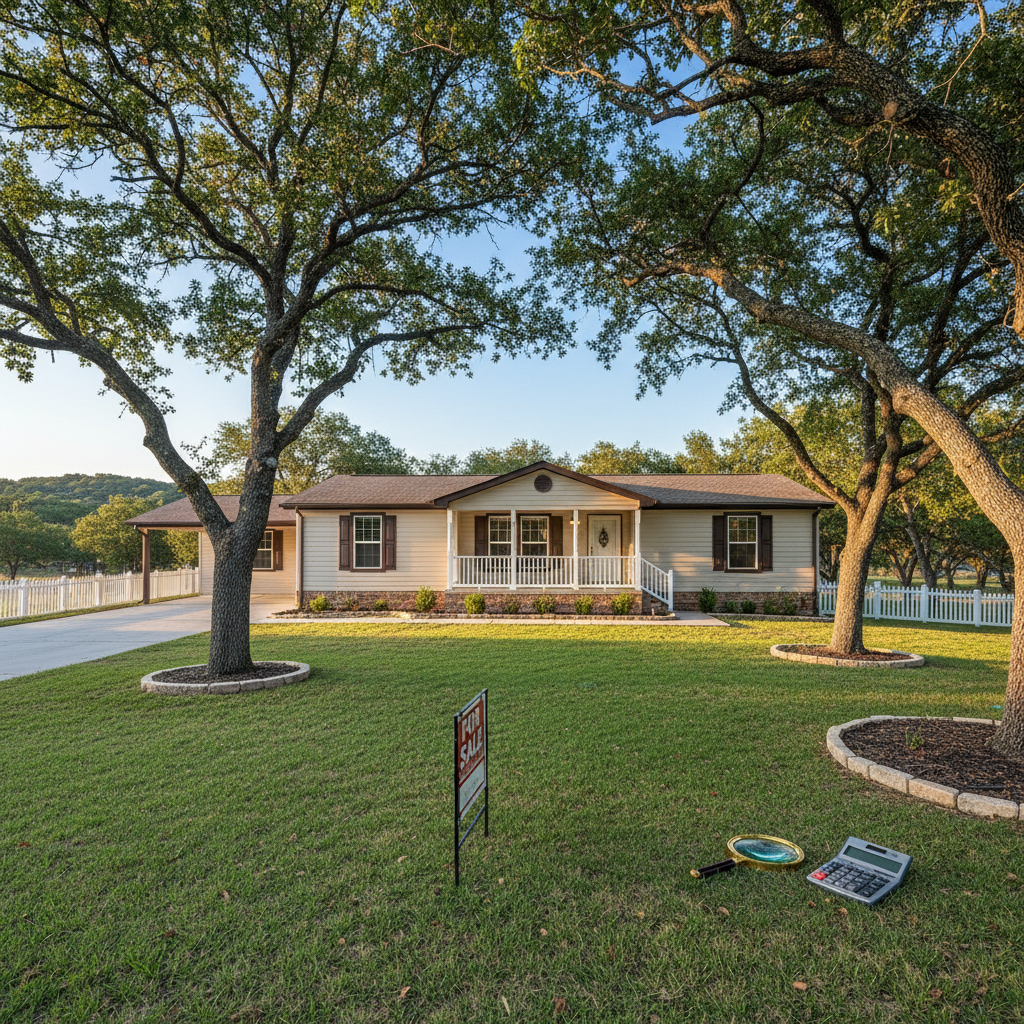
If you’re asking “how much is my mobile home worth?” you’re not alone—it’s one of the most common questions we get from Texas homeowners thinking about selling. The honest answer: it depends on far more variables than most people realize. A well-maintained double-wide on owned land in the Austin suburbs can be worth $120,000 or more, while an aging single-wide in a park with high lot rent might realistically fetch $15,000. This guide breaks down every factor that drives that gap, what real values look like across Texas in 2026, and how to figure out what your specific home is actually worth.
The 7 Key Factors That Determine Mobile Home Value
Mobile home valuation is not a single calculation—it’s the product of seven intersecting variables. Understanding each one helps you arrive at a realistic number before you ever talk to a buyer or broker.
1. Year of Manufacture
The year your home was built matters enormously, and not just for cosmetic reasons. Homes built before June 15, 1976 predate the federal HUD Manufactured Housing Construction and Safety Standards and are classified as “mobile homes” in the legal sense. These pre-HUD homes are harder to finance, harder to insure, and harder to resell. Post-1976 homes built to HUD code are officially “manufactured homes” and have far more buyer options available.
As a general rule, every decade of age reduces base value by 15–30%, adjusted for condition. A 1990 home in excellent shape can outperform a 2005 home that has been poorly maintained.
2. Size: Single-Wide vs. Double-Wide
Single-wides typically range from 600 to 1,300 square feet. Double-wides run from 1,000 to 2,400 square feet. Triple-wides and modular configurations exist but are far less common in the Texas resale market. Buyers pay per square foot, so larger homes command higher absolute prices—but the per-square-foot rate is often lower than site-built homes, especially in park settings.
A double-wide at 1,500 sq ft might sell for $55,000 while a single-wide at 800 sq ft in the same park sells for $28,000. The ratio is not linear because buyers also value the lifestyle difference between the two.
3. Condition
Condition is the single biggest variable you can control. Appraisers and buyers assess: roof integrity, HVAC function, plumbing and water damage, flooring, walls, doors, windows, skirting, and the overall cleanliness of the home. Water damage is the silent killer of mobile home values—even cosmetically repaired water damage often shows up in inspections and crushes buyer confidence.
A home in excellent condition can command a 30–50% premium over the same model in poor condition. See our guide on 5 things to do before putting your mobile home on the market for a condition checklist that matters to buyers.
4. Location
Texas is a big state with wildly different real estate markets. A manufactured home in the Austin metro commands multiples of what the same home would fetch in a rural East Texas county. Proximity to jobs, good schools, retail, and services all affect resale demand. Within a park, the location of your lot matters too—corner lots, end-of-row lots, and lots near amenities typically sell faster.
5. Land vs. Park (Real Property vs. Personal Property)
This is the most underappreciated value driver in manufactured housing. A home titled as real property (permanently affixed to land you own, with the title converted through TDHCA) can qualify for conventional mortgage financing and appreciates more like a site-built home. A home titled as personal property in a park depreciates like a vehicle and has a far narrower buyer pool.
All else equal, a manufactured home on owned land is worth 2–4 times more than the same home in a park. The land itself is a significant portion of that premium.
6. Single-Wide vs. Double-Wide (Layout and Livability)
Beyond raw square footage, the layout affects livability and thus buyer demand. Double-wides have distinct living and sleeping zones, more storage, and feel closer to a site-built home. This translates to a larger pool of interested buyers and stronger financing options. Single-wides, while more affordable, appeal to a narrower buyer segment.
7. Local Market Conditions
Supply and demand in your immediate area shape how quickly you sell and at what price. In markets with low manufactured home inventory (like parts of Austin and San Antonio), motivated buyers will pay at or near asking price. In markets with high inventory, you’ll face more competition and downward price pressure. Checking what comparable homes in your specific park or neighborhood have sold for in the last 90 days is the most reliable market signal available to you.
How to Use NADA Guides for Manufactured Homes
The NADA Manufactured Housing Appraisal Guide (now operated by J.D. Power) is the industry-standard reference for manufactured home valuations. Banks, dealers, appraisers, and insurance companies all use it as a baseline. Here’s how it works and what its limitations are.
What NADA Measures
NADA establishes a base value for a home using: manufacturer name, model name, model year, square footage, and floor plan type (single-wide, double-wide, etc.). From there, it applies adjustments for optional features and improvements—things like central air, upgraded appliances, decks, awnings, and storage buildings.
What NADA Does Not Measure
NADA is a desk valuation—it does not factor in the actual physical condition of your home, lot rent levels, park rules, or hyper-local market demand. A NADA report might say your home is worth $45,000 while the realistic sale price in your park is $28,000 because of $650/month lot rent and limited buyer financing. Treat NADA as a ceiling, not a floor.
How to Access a NADA Report
- Visit nadaguides.com and navigate to the Manufactured Housing section (there is a per-report fee)
- Ask a TDHCA-licensed broker—most have access to NADA and can pull a report as part of a free consultation
- Your local bank or credit union may run one if you inquire about financing
To get an accurate NADA report, you’ll need your home’s HUD data plate (usually found inside a kitchen cabinet or bedroom closet), which lists the manufacturer, model, year, and serial number.
Average Mobile Home Values in Texas by Age and Type (2026)
The ranges below reflect Texas market conditions in 2026 for homes in average-to-good condition. Homes in poor condition or located in high-lot-rent parks will fall below these ranges. Homes in excellent condition on owned land with real property status will exceed them.
| Home Type & Era | In a Park (Personal Property) | On Owned Land (Real Property) |
|---|---|---|
| Pre-1976 Single-Wide | $5,000 – $18,000 | $15,000 – $35,000 |
| 1976–1989 Single-Wide | $8,000 – $25,000 | $20,000 – $50,000 |
| 1990–1999 Single-Wide | $12,000 – $35,000 | $30,000 – $65,000 |
| 2000–2009 Single-Wide | $18,000 – $45,000 | $40,000 – $80,000 |
| 2010+ Single-Wide | $25,000 – $65,000 | $55,000 – $110,000 |
| 1990–1999 Double-Wide | $20,000 – $55,000 | $45,000 – $90,000 |
| 2000–2009 Double-Wide | $30,000 – $75,000 | $65,000 – $130,000 |
| 2010+ Double-Wide | $45,000 – $100,000 | $90,000 – $180,000+ |
Note: These are general Texas market ranges. Austin and San Antonio metro areas tend to run 10–25% above these figures. Rural and East Texas markets often run 10–20% below.
For context on how the broader manufactured housing market has shifted, see our overview of the Texas manufactured home market.
Why Mobile Homes in Parks Are Valued Differently
The distinction between a mobile home in a park and one on private land is not just a technical title issue—it fundamentally changes who can buy the home, how they can finance it, and what they’re willing to pay.
When your home is in a park, you own the home but not the land beneath it. You pay lot rent to the park operator, typically ranging from $350 to $800+ per month in Texas markets. This creates three major valuation headwinds:
- Financing is severely limited. Most conventional lenders will not finance a personal property manufactured home. Buyers are largely limited to cash, chattel loans (high-interest), or seller financing. This reduces your buyer pool dramatically. Read our chattel loan guide to understand what buyers face.
- Park rules restrict who can move in. Most parks have age restrictions, credit requirements, income requirements, and pet rules. Every rule is a filter that eliminates potential buyers.
- The home cannot fully appreciate. Because you don’t own the land, you can’t benefit from land appreciation. The home’s value is capped by what buyers are willing to pay for a depreciating asset with ongoing lot rent obligations.
For a deeper look at how to navigate park sales specifically, see our guide on how to sell a mobile home in a park the right way.
How Lot Rent Affects Resale Value
Lot rent is one of the most direct levers on your home’s sale price, and most sellers underestimate its impact. Here’s the math buyers actually use:
A buyer considering your home will look at their total monthly cost of ownership: lot rent plus any mortgage payment (if financed). If lot rent is $600/month, the buyer is essentially committed to $7,200 per year just to keep the home on the lot—before any other ownership costs. That shapes what they can and will pay for the home itself.
As a rough rule of thumb: every $100/month in lot rent reduces what a buyer is willing to pay by $5,000 to $10,000 in purchase price. A home that would sell for $50,000 in a park with $400/month lot rent might only sell for $35,000 in a park with $700/month lot rent.
Additionally, buyers know that lot rent can increase. Parks can raise rates with relatively short notice, and there is limited recourse for tenants in Texas. The uncertainty of future lot rent increases is itself a discount factor baked into every offer.
If your park’s lot rent has increased significantly in recent years, that is a strong argument for selling sooner rather than later—as rising lot rent continues to erode what the market will pay for your home. Call us at 737-214-0172 to understand what your home is worth right now.
Getting an Appraisal vs. a Cash Offer: Which Is More Accurate?
When sellers want to know what their home is worth, they usually have two options: hire a licensed appraiser or get a cash offer from a buyer. These are very different things, and the “accuracy” of each depends on what you mean by accurate.
The Certified Appraisal
A licensed appraiser physically inspects your home, reviews the NADA guide data, and compares your home against recent sales of comparable homes in the area. A certified appraisal typically costs $300 to $600 for a manufactured home and produces a formal written report that lenders will accept for financing purposes.
Pros: Objective, lender-accepted, based on physical inspection and comps.
Cons: Expensive, takes time to schedule, and comparable sales data for manufactured homes is often thin—especially in rural markets. An appraiser who doesn’t specialize in manufactured homes may produce an unreliable result.
The Cash Offer
A cash offer from a professional buyer like Mobile Bye Bye reflects what someone will actually pay you today—in cash, without contingencies, with a fast close. It accounts for lot rent, condition, local demand, title situation, and everything else that a NADA report ignores.
Pros: Free, fast, no obligation, reflects real market demand and real carrying costs.
Cons: A cash offer will typically be below a retail sale price because the buyer is taking on risk and delivering speed and certainty in exchange.
Our Recommendation
Get a free cash offer first—it takes 24 hours and costs nothing. Use it as your floor: the minimum you know you can walk away with, with no repairs, no commissions, and no waiting. Then decide whether it’s worth pursuing a retail sale or appraisal to try to exceed that number. Most sellers find the gap between the cash offer and a retail sale is smaller than they expected once they factor in lot rent, carrying costs, repair costs, and realtor fees.
What’s Your Home Actually Worth?
Get a free, no-obligation cash offer in 24 hours—no repairs, no commissions, no stress.
Get My Cash Offer →Red Flags That Tank Your Home’s Value
Certain problems go beyond cosmetic issues and can seriously reduce what buyers will pay—or kill a sale entirely. Being aware of these before you list your home gives you time to address them or price accordingly.
Title and Legal Issues
- Missing or lost Statement of Ownership (SOO): TDHCA requires a valid SOO for any legal transfer. A lost SOO must be replaced before sale, which takes time and involves fees.
- Incomplete ownership chain: If a prior owner never properly transferred the title to you, the chain of ownership is broken. This is common with inherited homes or informally purchased homes. It must be resolved before you can legally sell.
- Outstanding liens: Tax liens, mechanic’s liens, or lender liens on the home or the land must be cleared at or before closing. Buyers (and their lenders) will not proceed with an encumbered title.
- Wrong property location in TDHCA records: If TDHCA records show the home at an incorrect address, this creates complications that must be corrected through the agency.
Physical Condition Issues
- Water damage and mold: The number one deal-killer in manufactured housing. Roof leaks, plumbing leaks, and improper site drainage all lead to subfloor rot, wall damage, and mold—all of which are expensive to remediate and terrifying to buyers.
- Structural issues: Soft floors, sagging roof lines, and damaged marriage walls (in double-wides) signal structural failure that buyers will walk away from or deeply discount.
- Non-functional HVAC: Texas buyers expect working air conditioning. A non-functional HVAC system in a Texas summer is an immediate red flag.
- Fire or smoke damage: Even cosmetically repaired fire damage makes lenders nervous and buyers wary.
Situation and Location Issues
- Flood zone designation: Homes in FEMA Special Flood Hazard Areas (SFHA) require flood insurance that buyers must factor into their ongoing costs. This reduces demand and purchase price.
- Park closure or sale rumors: If a park is under contract to be redeveloped, buyers may be reluctant to purchase knowing they could be forced to move the home—a costly and sometimes impossible undertaking. Read our guide on selling a mobile home that needs to be moved if this applies to your situation.
- Very high lot rent relative to market: As discussed above, lot rent above $700–$800/month in most Texas markets makes a home nearly unsalable at any meaningful price.
For a full discussion of how depreciation compounds over time, see our guide on manufactured home depreciation and the top 10 reasons mobile homes lose value.
How to Maximize Your Home’s Value Before Selling
Not every improvement is worth making. The goal is to identify the changes that cost the least and recover the most in sale price. Here are the quick wins that consistently move the needle for manufactured home sellers in Texas.
High-ROI Improvements (Do These)
- Deep clean the entire home—inside and out. A spotless home photographs better, shows better, and signals to buyers that it has been cared for. This costs almost nothing and has an outsized effect on first impressions.
- Fresh interior paint. Light neutral colors make spaces feel larger and cleaner. A full interior paint job typically runs $800–$2,000 for a double-wide and can add $3,000–$6,000 in perceived value.
- Replace worn flooring. Stained carpet and cracked vinyl flooring are two of the most common reasons buyers submit low offers. Budget LVP (luxury vinyl plank) runs $1.50–$3.00/sq ft installed and dramatically changes how a home presents.
- Service the HVAC. A $100–$150 HVAC tune-up and fresh filters signals that the system is maintained. Have any obvious issues repaired before listing.
- Fix obvious water damage immediately. Replace soft subfloor sections, repair ceiling water stains, and re-caulk around tubs and sinks. Buyers assume visible water damage means hidden water damage—removing the visible problem removes the assumption.
- Improve curb appeal. Clean or replace skirting, mow and edge the lot, remove clutter, and add a few plants near the entrance. The exterior is the first thing buyers see.
Low-ROI Improvements (Skip These)
- Full kitchen or bathroom remodels
- Roof replacement (unless actively leaking—get a cash offer first)
- Room additions or expansions
- Upgrading appliances to high-end models
- Custom decorating that reflects personal taste rather than broad appeal
The golden rule: get a free cash offer before spending a single dollar on repairs. That offer tells you your baseline. Only spend money on improvements if you can confidently recover at least twice the cost in your final sale price.
Frequently Asked Questions
How much is a mobile home worth in Texas in 2026?
In Texas, mobile home values in 2026 range widely. A pre-1976 single-wide in a park may be worth $8,000 to $20,000. A well-maintained double-wide from the 2000s can be worth $40,000 to $80,000 or more. A newer HUD-code manufactured home on private land with real property status can command $80,000 to $160,000+. Location, condition, and whether the land is included are the biggest drivers.
Does a mobile home lose value over time?
Mobile homes generally depreciate when treated as personal property (titled separately from land), similar to a vehicle. However, manufactured homes on owned land that are converted to real property can appreciate over time, especially in high-demand Texas markets. The home itself loses value; the land beneath it often gains value. Use our free depreciation calculator to estimate how much value your home has lost based on age and purchase price.
What is the NADA guide for manufactured homes?
The NADA Manufactured Housing Appraisal Guide (now managed by J.D. Power) is the industry-standard reference for mobile and manufactured home valuations. It establishes base values by year, manufacturer, model, and size, then allows adjustments for features, condition, and location. Lenders, appraisers, and dealers all use it. You can access it at nadaguides.com for a fee, or ask a TDHCA-licensed broker to run a report for you.
Does lot rent hurt the resale value of my mobile home?
Yes. High lot rent directly reduces what buyers are willing to pay. If a buyer must pay $600 per month in lot rent, they need to factor that ongoing cost into the purchase price. As a rule of thumb, every $100 of monthly lot rent reduces what a buyer will pay by roughly $5,000 to $10,000. Homes in parks with lot rent above $700/month can be extremely difficult to sell at any meaningful price.
Is a NADA report the same as an appraisal?
No. A NADA report is a desk valuation based on statistical data—it does not involve a physical inspection of your home. A certified appraisal requires a licensed appraiser to physically inspect the property, assess condition, and compare it against recent comparable sales. Appraisals are required for most mortgage financing and are significantly more accurate for unusual or heavily modified homes.
What title issues can reduce a mobile home’s value?
Several title problems can tank value or kill a sale entirely: a missing or lost Statement of Ownership, an incomplete ownership chain (prior owner never transferred title), liens from unpaid taxes or loans, the home being listed on the wrong property location in TDHCA records, and estates where the home was never retitled after the owner’s death. Many of these can be resolved, but they take time and add cost.
Which adds more value: repairs or selling as-is?
It depends on the repair. High-ROI improvements include fresh paint, new flooring, HVAC servicing, and fixing obvious water damage. Low-ROI projects include full kitchen remodels, room additions, and major structural work. The rule of thumb: never spend more than 50 cents in repairs for every dollar you expect to recover. When in doubt, get an as-is cash offer first and use it as your baseline before spending a dime.
Can I get a cash offer without cleaning or repairing my mobile home?
Yes. Mobile Bye Bye buys mobile and manufactured homes in any condition, in any Texas location, with or without repairs. We’ll give you a no-obligation cash offer within 24 hours and can close in as few as 7 to 14 business days. Call us at 737-214-0172 or submit your information online.
Disclaimer: This article is for informational purposes only. Mobile Bye Bye is a TDHCA-licensed manufactured home brokerage — we are not attorneys, financial advisors, or legal professionals. Nothing in this article constitutes legal, financial, or tax advice. Consult a licensed professional for advice specific to your situation.
Ready to Find Out What Your Home Is Worth?
Skip the guesswork. Get a free cash offer from Mobile Bye Bye in 24 hours.
Get My Cash Offer →